Jacqueline Pretty
  • Home
  • Blog
  • Contact

Uncategorized 0 comments

How I ghost write a nonfiction book

Jacqui

May 3, 2024

Did you know that I had a not-so-secret, past life? While this website is focused on my fiction writing, for most of my career I’ve worked in nonfiction. This includes copywriting, content marketing and, from 2013-2019, running a publishing company called Grammar Factory that turned entrepreneurs into authors.

Grammar Factory started with my offering freelance editing services for nonfiction books written by entrepreneurs, and over time the business expanded to offer an end-to-end publishing service, including ghost writing. I still do some editing and ghost writing as a freelancer, hence this article!

What is ghost writing? Ghost writing is when someone other than the author writes a book. This might be because the author doesn’t have the skill, time or desire to write a book themselves, but they see the benefits in being a published author. The ghost writer’s name won’t appear on the cover of the book as the author – instead, they are charging a fee to write words that someone else will put their name on.

When it comes to the books I ghost write, it’s very important to me that it is the client’s book, not mine. This means it is based on their knowledge, skills and experience. In other words, it is a book they could have written, I just happened to be the one typing.

I achieve this by working very closely with the client, including with workshops, recorded interviews, consuming any content they’ve already published (e.g. blog posts, LinkedIn articles, webinars, podcasts, videos) and doing a lot of research using sources they recommend. The goal is for me to be able to write in their voice using their knowledge, rather than taking the topic in my own direction. Again, it’s their book and their knowledge – I’m just the one typing.

How does the process work? I’m so glad you asked. 😉

1. Client vetting

While I enjoy writing nonfiction books and working with entrepreneurs who want to become authors, I’m not the best match for every author or every book. I have a very specific skill set, and I want to make sure that I’m clear on what the author wants to achieve and they’re clear on how I work to make sure we’re a good fit.

This usually starts with the initial enquiry or introduction, when they’ll say a little about the book they want to write. What I do really well are nonfiction how-to and thought leadership books, and I work best when these books are targeted at a lay audience (meaning, the readers don’t share the author’s background and expertise). So when someone reaches out, I want to make sure they are writing this type of book – if someone wants me to help them with a memoir or fiction, I’m not the best person for this. Similarly, if they are writing for a highly technical audience, there are other writers who could do a far better job.

If the initial enquiry looks good, we’ll set up a time to connect to get more detail. In this call, I’ll ask:

  • What is the goal of the book? (E.g. what do they want it to do for their business or career?)
  • What is the main topic?
  • What type of book do they want to write? Is it a practical, how-to book with a step-by-step process their readers can follow? Is it a commentary on trends and challenges facing their industry, and how this will affect their readers going forward? Or would they like to do both?
  • Have they produced any content about this topic to date? (E.g. blog posts, brochures, webinars, podcasts, articles on LinkedIn and Medium, etc.)

If the book sounds like a good fit, the next thing I’ll check is ways of working. I have a certain process I follow when ghost writing a book, which starts with a full-day Book Blueprint workshop to get a high-level outline, followed by fleshing out the Blueprint to create an in-depth outline, followed by the first draft.

The reason I take this approach is because I want to make sure we’re on the same page as early as possible as, if we get the foundations right, that helps ensure the rest of the process runs smoothly. If we both agree to the high-level outline on the day of the workshop, the Blueprint document shouldn’t be a surprise because it’s expanding on what we already have. Similarly, if the client signs off on the Blueprint, the first draft shouldn’t have any major surprises, because it’s based on the document they’ve already reviewed. Because I have this process, I’m able to quote a fixed price and timeframe for delivering the book.

My goal is to avoid a situation where I disappear for three months, write a draft, send it to the client and it’s not what they were looking for, which means we need to start over. This approach takes much longer and is more expensive because of the level of work involved. It’s frustrating for the client, because they aren’t getting the result they wanted. And it’s frustrating for me as a ghost writer, as we all have a limited amount of mental and creative energy, and having to go back and redo significant amounts of work wastes this.

So at this point in the conversation, I’ll outline the approach and see if the client is onboard with working this way. Some people aren’t – they would prefer to have a constant back-and-forth with the author and develop their idea as they go. While there’s nothing wrong with this approach, it isn’t the way I prefer to work, so they would work better with a writer who’s comfortable with that approach.

This is also the client’s opportunity to ask questions about me and the way I work. If we both end the conversation and are happy to move forward, we’ll schedule a time for their Book Blueprint workshop.

2. Workshop prep

About two weeks before the workshop, I’ll send through a short list of questions to help them start thinking before the workshop.

These questions are:

  1. In one sentence, please summarise what your book is about.
  2. Who is the target reader for this book?
  3. What is your reader struggling with before reading your book, and how will your book help them?
  4. What is everything you’d like to include in this book?
  5. If you had to choose, what are the three most important things to include in your book?

The first three questions will build on our previous discussions, and help ensure we’re both still on the same page (which is important if there is a significant gap between the initial conversation and when the project kicks off).

Question 4 is their opportunity to brain dump. So many of the authors I work with have an endless flow of ideas and enthusiasm, which is awesome, but it can also threaten to derail the process. This gives them an opportunity to get it all down on paper, and it’s something for me to keep in mind as I’m writing the book.

Question 5 then forces them to prioritise. Books are a limited medium – there is only so much that can be covered, and you can only cover one thing at a time. This means you sometimes need to choose. Knowing what they think is most important helps me make the right choices.

3. Book Blueprint workshop

This is a one-day workshop where we follow my Book Blueprint method to create an outline.

This starts with the target reader – where they are before reading the book, and where we want them to be after the book. This discussion will look at problems the reader is experiencing and the roll-on effect of these (e.g. If they are low in confidence, what does that mean for their work and relationships? If they are following an old business model in an evolving industry, what is the cost to their business?), and we want to look at how the book will address these and the benefits the reader will experience going forward.

Once we have a very clear picture of the reader’s before and after state, the next step is to figure out how they get from A to B. This is a brainstorming exercise where the client will list all of the things the reader will need to learn/do/know in order to move forward. Once they have covered everything, I look for any groupings in what they’ve listed to come up with a series of steps, and we work together to find the best order for these.

Each of these steps (or, in a thought leadership book, each of the major topics) will become a chapter, and the next activity is diving into each one. For each chapter, we cover:

  • What are we talking about?
  • Why is it important?
  • How can the reader take action?

In most cases, there will be multiple ‘hows’ (activities or exercises) for each part of the process, so for each of these I will ask the same things – what are we doing, why is it important, and how can they take action?

Throughout the day, we’ll be working in a room with a whiteboard, or I’ll use big sticky notes on the wall to outline everything in front of the client. I find this approach works well, as they have time to think when I’m making notes, but also seeing the notes seems to spur on more ideas for a lot of people. It also means they know exactly what I’m writing down, so we both know we have the same understanding for the direction of the book.

By the end of the day, my goal is to have most (if not all) of the chapters outlined at a high-level. The resulting plan from this session is usually around 5,000-8,000 words. 

4. Building the Blueprint

Now I need to flesh out that plan to form a much deeper outline – one that includes all of the research, examples, exercises and anecdotes the client would use if they were writing the book themselves. By the time I’m done, I want a document so detailed that writing the book is easy – all I’ll be doing is expanding bullet points.

This is where I get deep into research. If the client has already created a lot of content, I will be reading through that and, in some cases, copying and pasting it directly into my working document. If not, I will ask them to recommend sources that they like – books, podcasts, YouTube videos, publications, academic papers – and I will use these to build out the plan. The aim is for this to feel like the client’s book, so I’m building my knowledge using the same resources they used to build theirs.

Over about four weeks, I will use this research to expand the Blueprint. After the workshop, I might have had a high-level list for each of the key points in the book, like:

  • Why is X important?
    • Reason 1
    • Reason 2
    • Reason 3

During this phase of the project, it will expand to be more like this:

  • Why is X important?
    • Reason 1
      • Author anecdote about seeing this in practice
      • Industry survey that backs up the author’s experience
    • Reason 2
      • Academic research to illustrate this
      • Leading companies that are changing as a result
    • Reason 3
      • Summary of findings from a reputable article that illustrates this point
    • Company case study that illustrates the previous three reasons

(Obviously, things are more detailed when there’s actual content there, but this gives you an idea of the sort of expansion that happens at this step.)

For the most part, I go into hibernation in this process and work very independently. If the client send through articles and other interesting resources while I’m working on this, I’ll review these and see where they can be added in, but there’s no obligation for the client to do this.

What I usually find between the 50-75% mark is there are certain areas where there isn’t good research to back it up, or areas where I want to incorporate more of the client’s experience and story. In this situation, we’ll have a follow-up call where I’ll ask targeted questions to get examples that will slot into the plan.

By the end of this stage, I want to have a Blueprint document that is around 30-50% of my expected word count for the first draft. (In a recent example, I had a 130-page document at the end of this process, which was 30,000 words.) I then send this to the client for review.

Because started with the workshop, I’m not expecting significant changes at this stage – the overarching topics we discuss and the structure should remain the same. If they have feedback, it’s usually along the lines of, ‘I have a great example that could fit in here!’ or ‘can we go into more depth on this topic?’ In other words, we’re looking at things that can slot into the existing structure.

This stage is about 70% of the work on the project, as this is when all the thinking and research happens. This is why it’s so important for us to be on the same page at the end of the one-day workshop, because if things change significantly at this stage, we lose a lot of the work.

What is a significant change at this stage? Aside from wanting to write a book about a completely different topic, these are also big changes:

  • Changing the type of book. If we decided to write a how-to book, and then the client decides they would prefer to do a memoir once the Blueprint is complete, this is a significant change. It’s an entirely new book, and means we are starting the process again.
  • Changing the method/overall structure of the book. If we defined a seven-step process in the workshop, the client coming to me saying they like three of the steps but don’t like the others is a big change. Or if they say they want to make the process 10 steps instead, that’s also a big change.
  • Changing the target audience. This isn’t always a big problem, but it has the potential to be. Different readers have different wants, needs and goals. This means we write different content to suit them. If someone starts a book saying that it’s targeted at the average person on the street and then wants to reposition it so it targets executives looking for enterprise solutions, this will require significant rework – even if it’s a how-to book where the steps are the same, the reasons those steps are important will change depending on the audience, and how they will be implemented could change as well.

All of these changes would mean we’d have to go back to the Book Blueprint workshop and re-outline the book, and then I would need to redo the Blueprint document. Yes, there might be some content that I could copy from one version to another, but it requires a significant amount of rework and rethinking, to the point where we are nearly starting again.

Basically, what we want at this stage is feedback and changes that slot into the existing outline, nothing that significantly changes the outline.

5. Writing the draft

If everything goes well with the review of the Blueprint, I start writing! While I allow more time for this stage, it’s actually the easiest step in the process. Like I mentioned earlier – finishing the Blueprint means that 70% of the project is done – all the research and thinking has been completed, so writing the draft is just a matter of typing.

Of course, things do come up when I’m writing – I’ll realise an example doesn’t work as well as I’d originally thought it would, or that an exercise is missing a step, or that a section feels a bit light compared to others. If this happens, I’ll do some more research or reach out to the clients with questions to flesh things out.

In practice, this means in the first half of the time allocated to writing the draft, I will do a first pass of every chapter of the book. In this first pass, I aim to have a draft that is 80% complete. If there is anything I can’t complete when drafting (e.g. seeing that I need more research or client input, noticing that something isn’t flowing as well as I’d like it to), I will leave it in order to maintain momentum.

Once I’ve done that first pass, the next stage is to go back and address all of my outstanding comments. In a six-week drafting period, I’d expect this to take 2-2.5 weeks, so almost as long as getting the first 80% written.

In the final week, I will be tidying everything up before handing the draft over to the client. This will include:

  • Creating diagrams and tables (where necessary) throughout the book (these aren’t the final, designed versions, but something the designer can use as a starting point when we hand the document over)
  • Applying correct formatting styles across the document (this makes it look more polished, and also makes things easier when we hand it over to a designer)
  • Completing full, academic referencing for sources used throughout the book (this is surprisingly time consuming!)
  • Printing out the draft to read it and make notes of areas for improvement (it’s always helpful to read things in a different format – it tricks your brain into seeing it as something new, instead of glossing over things due to your familiarity with the content)

6. Revisions and sign off

Now the client reads the first draft of their book! My standard packages include two rounds of revisions, and allows two weeks for each of them.

Like when the client is reviewing the Blueprint, I’m expecting changes to be pretty minor. These will be along the lines of, ‘can we add another example here?’, ‘what if we add an anecdote here?’, or ‘I found a newer paper that we can reference here, instead of the one you have.’

Changes at this stage are usually small additions or direct substitutions (like switching one reference for another, or adding a new example). Because the client has already signed off on the Blueprint at this stage, they already know what to expect in terms of the content that will be shared and how it will be organised, so there shouldn’t be any changes in terms of structure or content.

And there you have it! 

What’s next?

From workshop to sign-off, my ghost writing process takes 12-14 weeks, broken down as follows:

  • Blueprint workshop: One day
  • Blueprint: Four weeks
  • First draft: Six weeks
  • Revisions: Two weeks for each round, up to two rounds

Assuming the client and I are both satisfied with the outcome of the Blueprint workshop, this schedule is very reliable. If we don’t have a successful Blueprint workshop (usually either because the client isn’t sure what they want or hasn’t gotten clear enough on the idea, or because we find out the book doesn’t sit in my wheelhouse), then we’d have a conversation about either regrouping at a later date, or about me referring them to another ghost writer who might be a better match.

From here, the client will then look at publishing the book. If they want to traditionally publish they would put together a proposal they can use to pitch publishers (note that this can take place while I’m writing the book – there’s no need to wait for a finished draft before you start pitching). If they self-publish, they will either work with a self-publishing company like my old business (in this approach, the self-publishing company will have a team of professional editors and designers and will charge a fee to produce a first-class print and eBook and distribute it online), or they might engage their own team of freelancers to produce the book. 

Did you find this interesting? Did you have more questions about the ghost writing process? If so, please comment to let me know!


Uncategorized 0 comments

Understanding burnout for writers – 4 concepts that are changing my life

Jacqui

February 26, 2024

Last week my monthly newsletter went out, and I shared what I’ve been learning about burnout from Becca Syme, creator of the Better Faster Academy.   

I learnt about Becca through another author in December and, once I saw she had burnout-related content, I devoured it. I read her book on the topic, binged her podcast series about it, and even signed up to an exploratory coaching session. (If you’ve done any coaching with her team, let me know what your top Clifton Strengths are – it’s super interesting.)   For the first time, I found burnout described in a way that felt actionable to me, and in a way that made sense for my dreams as a writer. 

While I’d originally planned it as newsletter-only content, I think it’s something that could help a lot of writers, so thought, why not share it here as well?

The most helpful thing for me was the language she gave me to describe burnout – energy pennies, plates, pits, and ladders.  

Before we get into that, though, I send a newsletter once a month that shares an inside look at my writing life, new release updates, interviews, events, giveaways and occasional deep dives like this. If you sign up below, you’ll also get the first three chapters of Powerless for free 😉

Blog posts

Energy pennies

Energy pennies are fairly straightforward – everything you do (mental, physical or emotional) has an energetic cost. Some activities cost more than others – a six-hour, uphill hike will cost more than a 20-minute stroll on level ground. And if you have to use willpower to do something you don’t want to do, that costs more again – because the willpower costs pennies in addition to the task you’re trying to complete. 

 This is similar to the spoons theory, where each spoon represents a certain amount of energy, but I find the idea of energy pennies to be far more intuitive. Pennies are a type of currency and, even if I can’t put an exact value on the balance in my account, or the cost of certain activities, I understand the ideas of spending and saving these. Spoons never quite clicked in the same way. 

 Beyond spending your pennies, there are also things that can give you energy pennies. Eating and sleeping are obvious ones, along with activities you find nourishing. In my case, reading, walking and singing are big ones. But there’s a balance – if I’m pushing myself to read a book that I’m not getting into, that can end up costing me pennies instead of creating them. Similarly, walking can be a bit of a challenge – I used to love long walks (90 minutes plus), but now I find that anything over 45 minutes puts me into risky territory, and sometimes I can only manage 20. When you’re burnt out, the challenge is maintaining the balance.

Plate size

Plates relate to the idea of having a lot on your plate. Becca says everyone has a plate, and they may be different sizes. So some people might naturally have a size 10 plate, which means they have the capacity to get a lot done, while others might have a size three plate, and aren’t able to manage as much.

Your plate size tells you how much you can comfortably take on without getting burnt out. When you start to take on more than that amount, the contents on your plate start to bleed from the main part of the dish (where you would put a meal) to the lip around the edge. If this keeps happening, your plate will overbalance and flip over. This is burnout. If you go through burnout, when you recover, your plate often isn’t the same size it was before. This has been my experience – when I think back to my first couple of years in business (if you’re new here, I had a publishing company called Grammar Factory from 2013 to 2019), I definitely had a size 10 plate. Even now, I’m in awe of how much I managed to get done, how much information I could hold in my head, and how many balls I could juggle concurrently. 

 
 The first time I burnt out was in 2015, after six months of 12-hour days, seven days a week, where I was editing multiple books at a time, training new staff members, reviewing all their edits, and writing a book of my own. After this, I got to the point where I would just stare at my computer watching YouTube, unable to do anything that required input from me. 
 
 Even though I did recover, I don’t think I’ve ever gotten back to having a size 10 plate – the highest was probably a seven (and now I’m around a three to four, depending on the day).

The pit

Once you burn out, you fall into the pit. This is the lowest of the low – whatever that might mean for you.

I struggled to claim the title of burnout in the past, because I didn’t think things were bad enough. I read articles about people who were unable to get out of bed for six months and, being a very literal person, I thought that if I was getting out of bed, I must have been okay. 
 
Last year I started thinking of my situation as ‘high-functioning burnout’. Even though I felt exhausted, sometimes emotional, and I couldn’t focus or produce the way I used to, I could usually get it together for a couple of hours if I had to. I could put on a nice outfit and a smile and force myself through two or three hours of meetings or an event, and no one would know anything was wrong. What they didn’t know was that as soon as I got home (or as soon as I hung up on Zoom), I would be staring at my computer screen, unable to put words together, or lying in bed to recover. 
 
 I’ve been here three times – in 2015, in 2022 when I had a job that was both high-powered and toxic, and from November 2023 to January 2024.

The ladder

The final metaphor is the ladder – this is how you get out of the pit. You see, the pit is too deep for you to just jump out – you need to build a ladder.

The challenge is that it takes energy to build that ladder – every rung costs energy pennies. You might build a rung, and then get stuck there for a bit while you save up more pennies.   
 
What happens with a lot of people (especially me), is that you climb up a few rungs and start feeling better. Not 100%, but you start to feel like you’re on the road to recovery. Then, because you have a little more energy, you decide to try pushing yourself like you used to in the past.   
 
That then knocks you back into the pit.   
 
This has been my story over the past two years. After I resigned from my job In August 2022 and moved back to Australia, I was lucky to find a role with much less responsibility. Over the next couple of months, I started feeling better.   
 
And then I decided it would be a good idea to try to write a book in two weeks! 
 
In hindsight, I realise that this was not the best idea – this challenge used precious energy pennies that could have been spent continuing to climb up the ladder, and after pushing myself like this, I struggled to write for the first half of the year. (To be fair, publishing Powerless might have had an impact on this as well.) I wasn’t back in the pit, but I was back down on the lower rungs of the ladder.   
 
Then, in June, Powerless came out and I found out about my husband’s affair. This was a challenging period and while I wasn’t feeling 100%, I was largely positive after the initial shock.   
 
It wasn’t until November that I fell back into the pit. I had managed to maintain my hold on my rung of the ladder. But, in November, our house had been on the market for six weeks (which meant the work spent fixing it up and cleaning for biweekly inspections), I’d just bought a new apartment, I faced a challenging situation in my day job, and I agreed to take on a ghost writing project.   
 
Three weeks into the project and I was running behind. I was anxious about the lack of interest in our house, and feedback that our bathroom and kitchen needed renovating, and I decided to paint the grout in the bathroom tiles. I thought this would be a two-hour job, and it ended up taking fifteen.   
Fifteen hours on my hands and knees, scraping grout paint from every tile before the next inspection, while I had an angry colleague messaging me and a ghost writing deadline hanging over my head.   
 
After this I crashed. I stepped back from the project, did the bare minimum at work and on the house, and spent the next two months on very shaky ground.   If I’d known about the ladder back then, I might have behaved differently.

Recovery

When I came across these ideas in late December, for the first time I felt like I had language to describe how burnout worked. The plate metaphor helped me understand why I don’t have the same capacity I used to, while the energy pennies and ladder metaphors helped me understand why I haven’t been able to push or challenge or hustle my way out of this.

In 2024, my top priority is recovering from burnout. That means being very careful with my energy pennies – taking time to do things that replenish them, and avoiding things that drain them where possible.   
 
It means some compromises – I had originally hoped to release the sequel to Powerless in the first half of the year, and that definitely won’t happen. I’d also planned to return to that ghost writing project in February after I moved into my new place and, at the time of writing, I’m considering telling the client I’m still unable to take it on. I’m also considering my options for stepping back from work – whether it’s possible to take an extended holiday or leave of absence.   
 
It means difficult conversations. The client one in particular is difficult – I’ve always believed in honouring my commitments, and this client and I have a relationship that goes back almost ten years. I don’t want to let him down. Similarly, my new company has been so good to me that I don’t want to let them down.   But I also can’t keep letting myself down. I don’t have the resources left.   
 
While this might sound a bit depressing, I find it hopeful. Understanding that I can budget and save my energy pennies gives me hope. Understanding that there’s a ladder I can climb out of the pit makes me feel positive about my ability to build a sustainable future. It means my writing might not happen as quickly as I want it to, but now I understand why and can avoid this pattern of burning myself out in future.  

Uncategorized 2 comments

Powerless FAQs – what people also asked

Jacqui

February 11, 2024

Text contentHere are the answers to some common questions that people people have asked about my debut novel, Powerless:

What is the book Powerless about?

Powerless is a young adult novel about Hanna, a 16-year-old girl who is the only one of her siblings who doesn’t have super powers. Her father, Artem, is the scientist who discovered the super gene mutation and he is losing patience with Hanna.

When a suspected research leak leads him to kick her out of the family home, Hanna tangles with the Russian mafia and needs to question where her loyalties lie, and how far she will go to be accepted by her family.

What is the age rating for Powerless?

Powerless is a young adult book, and I’d recommend it for readers over 14 years old because of some of the darker themes (see the trigger warnings below). However, you know your (or your kids’) reading preferences, so you can decide if it’s an appropriate read accordingly.

What are the trigger warnings for the Powerless book?

Powerless contains strong language and depictions of self-harm, violence, depression and unhealthy family dynamics. Please be mindful of these and other possible triggers if you choose to read it.

Is Powerless a spicy book?

No, Powerless isn’t spicy and doesn’t have a romantic subplot.

While I love a good romance, one of the things that has always frustrated me is how much importance romantic relationships are given over other relationships in fiction. I also think that, for some people, if you’re fighting for your life, you’re probably not thinking about romance, but maybe that’s just me. 😀

In Powerless, the emotional heart of the story is the relationship between Hanna and her sister, Maria.

Is the Powerless book clean?

When it comes to romance, there is no romance and no spicy scenes. However, there is on-page violence and self-harm, as well as strong language.

Is Powerless a good book?

I think so! You can check out the Powerless Goodreads page for reader reviews – it currently has a rating of 4.3 stars.

How many pages are in Powerless?

The hardcover is 308 pages and the paperback version is 397 pages (the stories are the same, but the page count is different because the pages are different sizes in the different versions of the book. Bigger pages = more words on a page = fewer pages).

Does Powerless have a happy ending?

Powerless has a happy ending, where the major threat is taken down. However, a number of things are left open and will be resolved in the sequel.

Will there be a sequel to Powerless?

Yes, my plan is for Powerless to be a duology. The second book will tie up a number of loose ends from the first one, we will learn more about Hanna and her siblings, and the book will include Maria’s point of view as well as Hanna’s.

I can’t go into the plot without spoiling Powerless, but rest assured there will be brutal fights, emotional clashes, new superpowers and secrets revealed.

Order Powerless

Want to learn more? Order Powerless using the linked images below, or search for “Powerless Jacqueline Pretty” at your favorite book retailer. Or, sign up to read the first three chapters, free!

Powerless FAQs – what people also asked

Uncategorized 0 comments

Learnings from marketing my debut novel

Jacqui

October 23, 2023

It has now been four months since I released Powerless, so it’s time for a retrospective on what worked and what didn’t when it came to my marketing strategy.

As I mentioned in the post on my marketing plan, my strategy had four pillars, each with different goals:

  • Content marketing – goal to build an audience and deepen my relationship with my readers
  • Influencer outreach – goal to build awareness about Powerless
  • Reviews – goal to build awareness and increase social proof around the book’s quality
  • Paid promotions – goal to drive traffic to my book on Amazon and get sales

The results

Rather than making you wait until the end of the post to find out how I went, you’re getting the results up front! (Keep reading for an activity-by-activity breakdown.)

Drumroll please…

It didn’t go very well 😅

From April (when Powerless was available for pre-order) to the date of writing (October 23rd), I have sold a whopping 169 copies of the book!

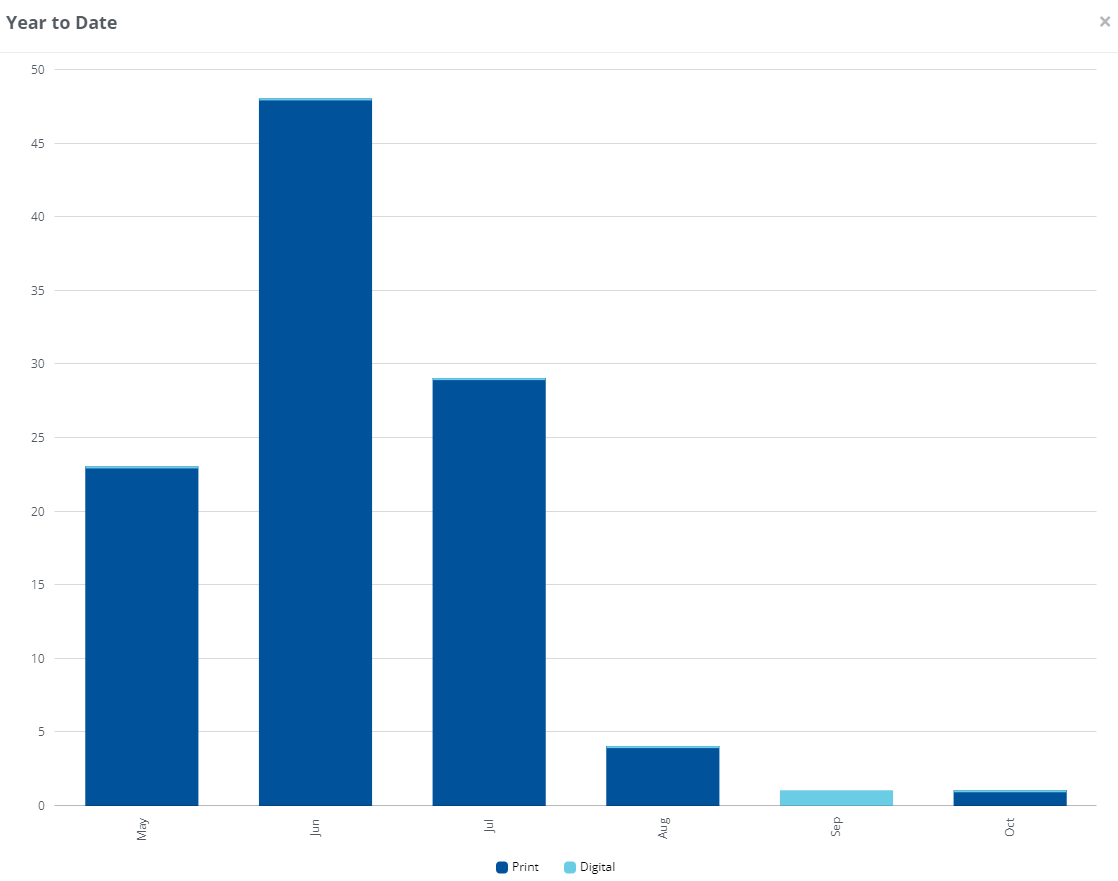
The breakdown is 105 print copies and 64 eBooks (I’m very surprised that there are more print copies than eBooks – don’t people know the eBook is only $2.99?). On top of that, I have also distributed 350 copies through giveaways.

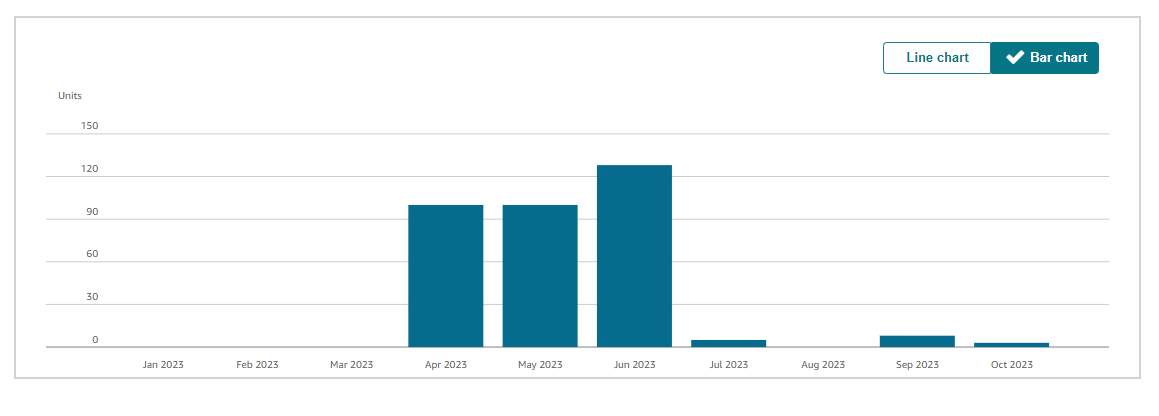
Most copies were sold in June (release month) followed by May (pre-orders). After July, there was a significant drop off, which I think is a combination of the people who know me in real life having already ordered, as well as a drop off in marketing.

IngramSpark book sales
Amazon kindle orders (Note that the Amazon chart includes 100 giveaways in April, May and June, so actual sales are much lower)

What went wrong?

When I outline my main marketing activities and their results, you’ll see it’s a challenge to pinpoint any one thing that went wrong, simply because nothing went right. Most marketing activities simply weren’t that effective when it came to driving sales. They also weren’t that effective when it came to driving other metrics, like increases in newsletter subscribers or social media followers.

Having said that, there’s definitely more that I could have done. I could have continued pushing Powerless after the launch and might have seen an uptick in sales over time.

However, I had some personal things going on as well, which meant Powerless became less of a priority. 

The biggest thing was, six days after Powerless came out, I discovered my husband had been having a multi-year emotional affair. I won’t get into too much detail about it here, but this was a big shock, and one that led to me starting to burn out again (when I was still recovering from burnout caused by a toxic work environment last year).

This revelation led to a decision to separate. We’re still in the process of doing that, with our house currently on the market. 

At the same time, I was diagnosed with endometriosis and ended up having surgery to help with this a few weeks ago. This was nowhere near as big a hit as the previous revelation, but it did feel like a lot to deal with at once.

Ultimately, I needed to take some space to heal. Not only did I step back from marketing Powerless, but I also stepped back from writing, as I wasn’t in a healthy enough place to add the pressure of writing more books to the mix.

So I fully acknowledge that, theoretically, I could have done more to increase my book’s success. Unfortunately, circumstances didn’t make that possible this time around.

Now that that’s out of the way, let’s look at some numbers!

Content marketing

In my last blog post, I shared the schedule I had for sharing various types of content. Obviously, that went out the window for reasons stated previously, so I’m going to share content I shared with the goal of marketing Powerless, and my metrics for each platform.

These metrics cannot be tied directly to book sales, however, my hope was that if my audience grew through these channels, over time I would see an uplift in sales (maybe not for Powerless, but for future books).

Instagram

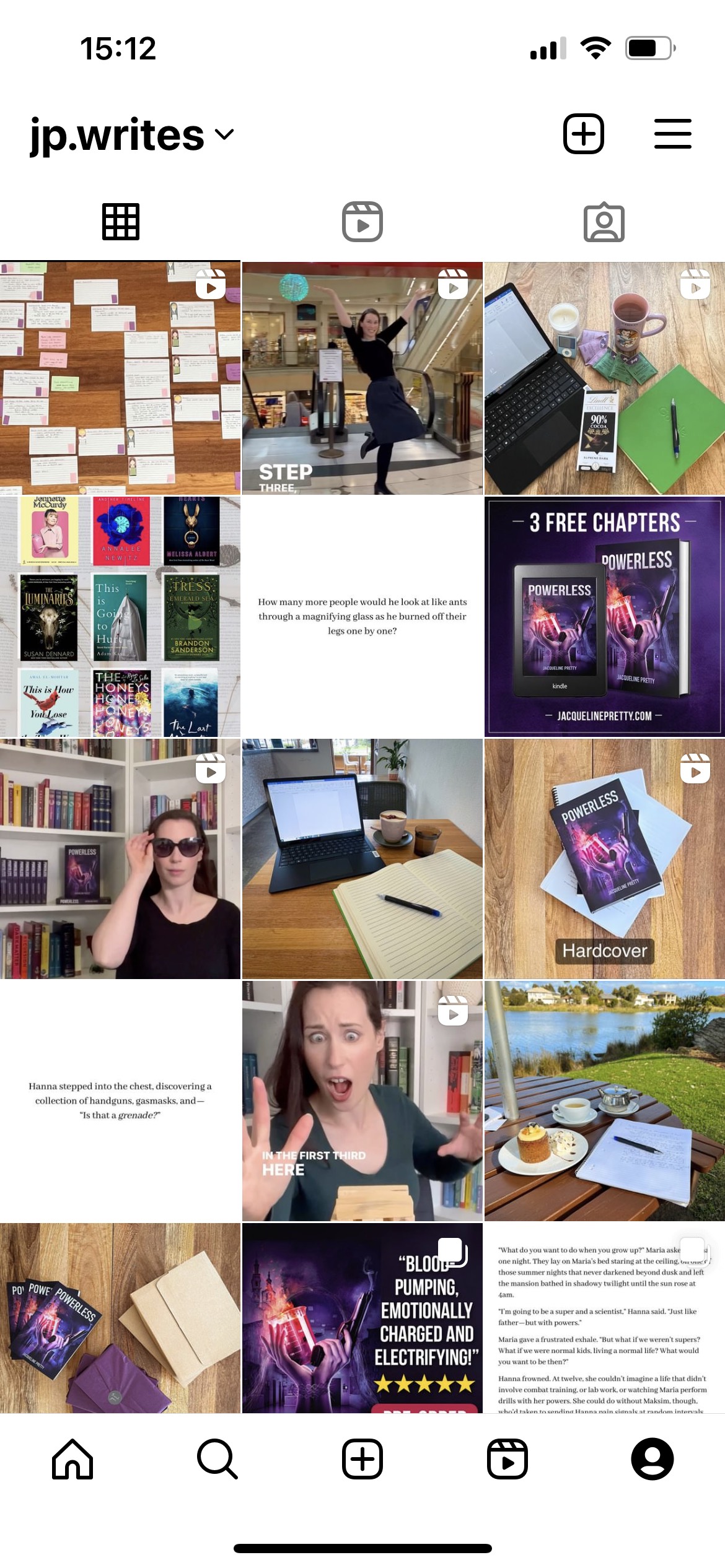
Instagram was my most active platform through the course of the campaign, where I shared quotes from Powerless, writing updates, reading updates and silly reels.

My Instagram grid - follow me at jp.writes ;)
My Instagram grid – follow me at jp.writes 😉

From February 4th (when I posted my first Powerless-related content) to June 20th (when the last one went out) I published 52 posts and shared stories on over 80 days.

Unfortunately, Instagram doesn’t allow you to see account insights that are older than 90 days, which means I can’t see how things performed over this period 😥

Off the top of my head, there were a couple of experiences worth highlighting.

The first is that one of my reels went viral (for me), reaching 122,068 accounts. It had 122,416 plays with over 350 hours of watch time and 493 likes, all of which are very high for me. However, there were only four comments, and this didn’t lead to any more followers.

So I had very large reach with this post, but it didn’t amount to much in the end. I never expected Instagram to lead to book sales (I thought it would be more of a tool to build awareness and an audience), but it was quite surprising to get that level of reach and not grow my audience at all.

This was also the case for another couple of posts that got some organic exposure (3K+ views each) – while the number of viewers was much larger than the number of followers, it didn’t lead to an increase in audience size.

The only thing that led to a growth in audience numbers was influencer marketing, which I’ll cover in the next section.

The verdict? I found that my own activity didn’t lead to an increase in followers or much buzz about the book, even when I had a post organically reach a large audience. Having said that, I did enjoy creating this content (and I like scrolling back through it), so it’s something I’ll probably return to in future – at least around future book launches. 

Blog content 

My blog was never a priority, even before I stepped back from marketing Powerless. I wanted to have a few posts on my website so that there was something people could engage with if they liked my stuff, but wasn’t worried about having a regular schedule.

The plan was, if I had something to write, I would write it. If not, I wouldn’t worry.

With that approach, I published four blog posts in the lead up to the Powerless launch. 

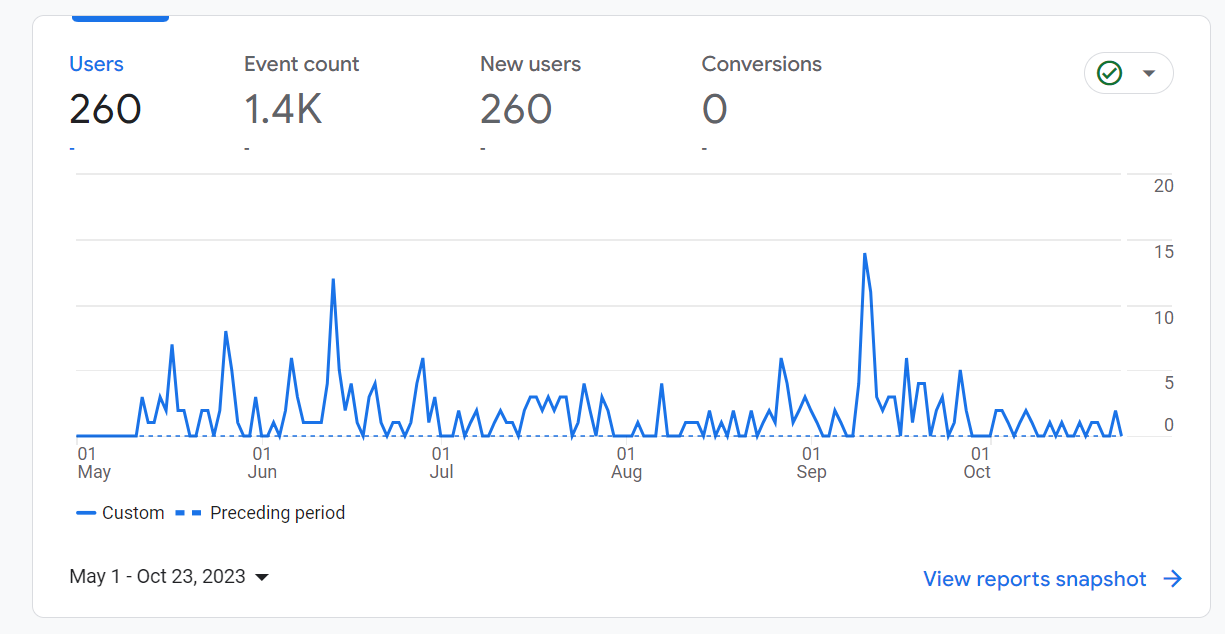
Because I didn’t promote those posts (I think I mentioned one of them in my newsletter?), there’s no correlation between when the posts went out and my website’s traffic. My traffic was highest during the week of the Powerless launch (that’s the spike in June), and then I had a random spike in September – no idea what this was about.

(When we talk about ‘spikes’, though, it’s less than 15 visitors a day, so not a statistically significant number 😂)

Google Analytics dashboard.

The verdict? I think I had the right approach here – it’s nice to have blog posts so that readers have something to engage with when they decide they like you, but I wouldn’t make it a regular activity.

YouTube

I’d been off YouTube for about a year before I announced that I was self-publishing Powerless, so YouTube engagement was always going to be a bit of an uphill battle.

My last few videos before I disappeared were about the Netflix series Arcane, and they went viral (at least for me), with the top one getting over 50,000 views and the series pushing my subscriber numbers from around 500 to over 1,000.

If I’d kept publishing video essays then, I probably would have had a more sizeable audience to share Powerless news with. Unfortunately, those videos released right before my job at the time became toxic and I burnt out, so it wasn’t ideal 😅

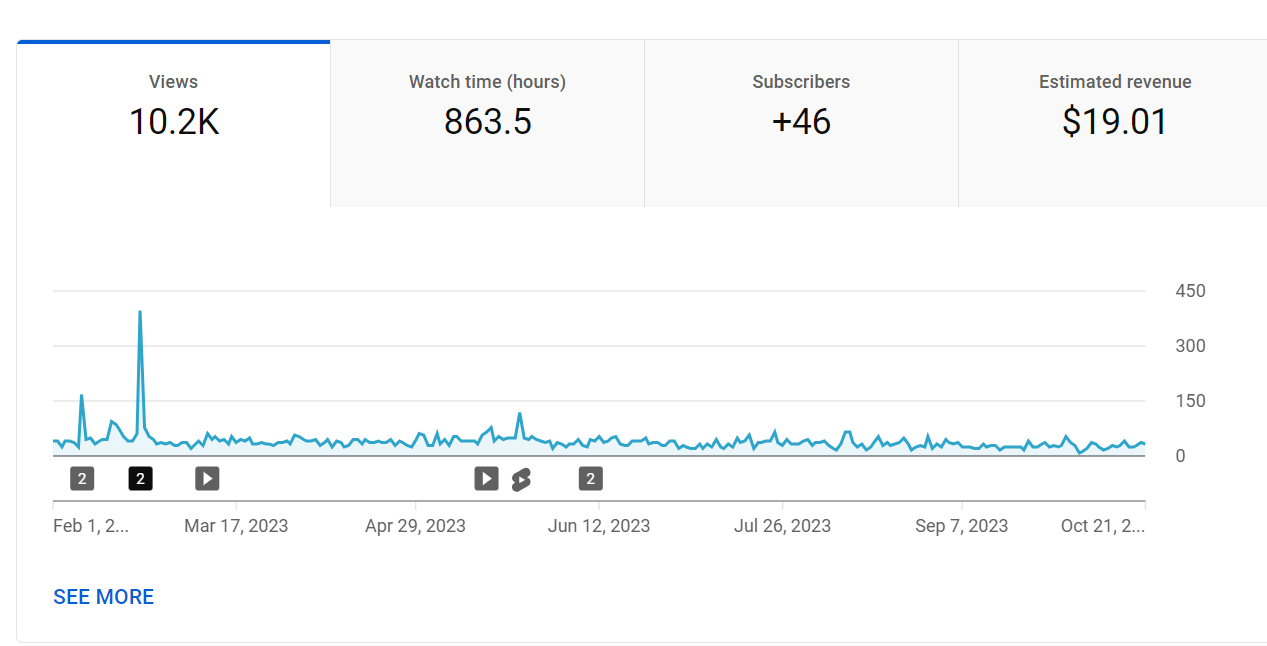
From February 9th to June 15th, I published nine videos – five shorts, three videos between 10 and 30 minutes, and one 70-minute livestream with fellow authortuber Nicole Wilbur.

YouTube analytics for jpwrites

You can see there was a spike in views at the end of February – I think this was the algorithm being kind, probably hoping I was going to be producing content regularly again, but also promoting the new shorts I was sharing. After that, you can see the views are low but steady, adding up to 10.2k views from February until now and 46 new subscribers. (And $19 in revenue! One day I might hit $100 and actually get a cheque! 😂)

The verdict? I think YouTube had much more potential – if I had been publishing content there like I had been on Instagram, I think I might have gotten more interest from my current subscribers, and more love from the algorithm. If I’d jumped on a trending topic, like with Arcane last year, I might have even gotten another viral boost.

This is entirely on me – I didn’t put the effort into making this platform succeed. 

Like everything, it’s about prioritisation. YouTube content takes a lot more time than what I was producing for Instagram, and it ultimately became a decision between prioritising writing and prioritising video content.

I’m not sure what to do from here – I’ve probably missed the opportunity to regain the traction I had last year, so the question becomes, is it worth putting in minimal effort (like I’ve been doing), when the new content isn’t getting the same engagement as my old content? Or should I just wait until I can do regular content and really push the channel once more, and hope for another viral spike?

At this point, I know I couldn’t do regular content – I have a day job, am going through a separation and am managing health things. If I’m going to commit to something other than that, it is getting back to writing the sequel to Powerless. But I do wonder…

Newsletters

In January, I started sending a monthly newsletter. I was confident I could keep up the once-a-month schedule, regardless of what was going on in my life. Then my marriage ended. 😂

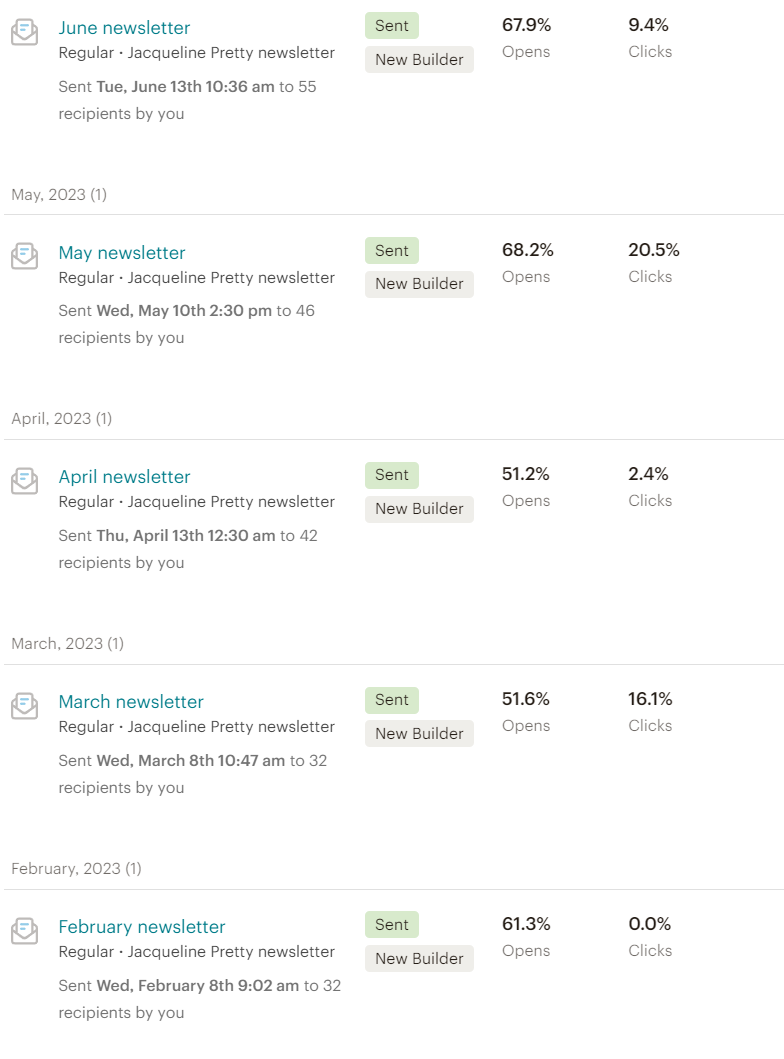
The open rates for these emails are very good (usually over 60%) and the number of people who clicked varied depending on how prominent the call to action was – emails with pre-order buttons got more clicks than those with links in the text.

My Mailchimp newsletter stats

Like my website, the numbers are very low, meaning that the high stats aren’t actually reliable, as one extra person opening is enough to change those metrics.

However, if I had 5,000 people and was getting those open and click rates, we’d be having a very different conversation.

The verdict? An email list is a huge asset, once you grow it. Obviously, mine’s very small at the moment, but I think a monthly newsletter is a good strategy to keep them engaged and then (hopefully) convert them on future books.

While you’re here, why not sign up? Once a month, you’ll get an inside look at my writing life, new release updates, interviews, events, giveaways and more! Plus, you’ll also get the first three chapters of Powerless when you subscribe 😉

Blog posts


Influencer marketing

In my last post, I shared my method for reaching out to podcasters, YouTubers, bloggers and Instagrammers in the hope of getting them to cover my book.

By and large, this didn’t amount to much.

After filtering my lists based on genres and whether they were open for submission, I reached out to over 80 influencers across the different platforms. Of those, I believe two agreed to review/share Powerless on their platforms for free (one blogger and one Instagrammer).

Through this exercise, though, I stumbled upon the idea of Instagram book tours – where a group of Instagrammers team up to share your book. Generally, each tour company will do a one-week book tour of your book, where each day one or more people on the team will do a post about your book.

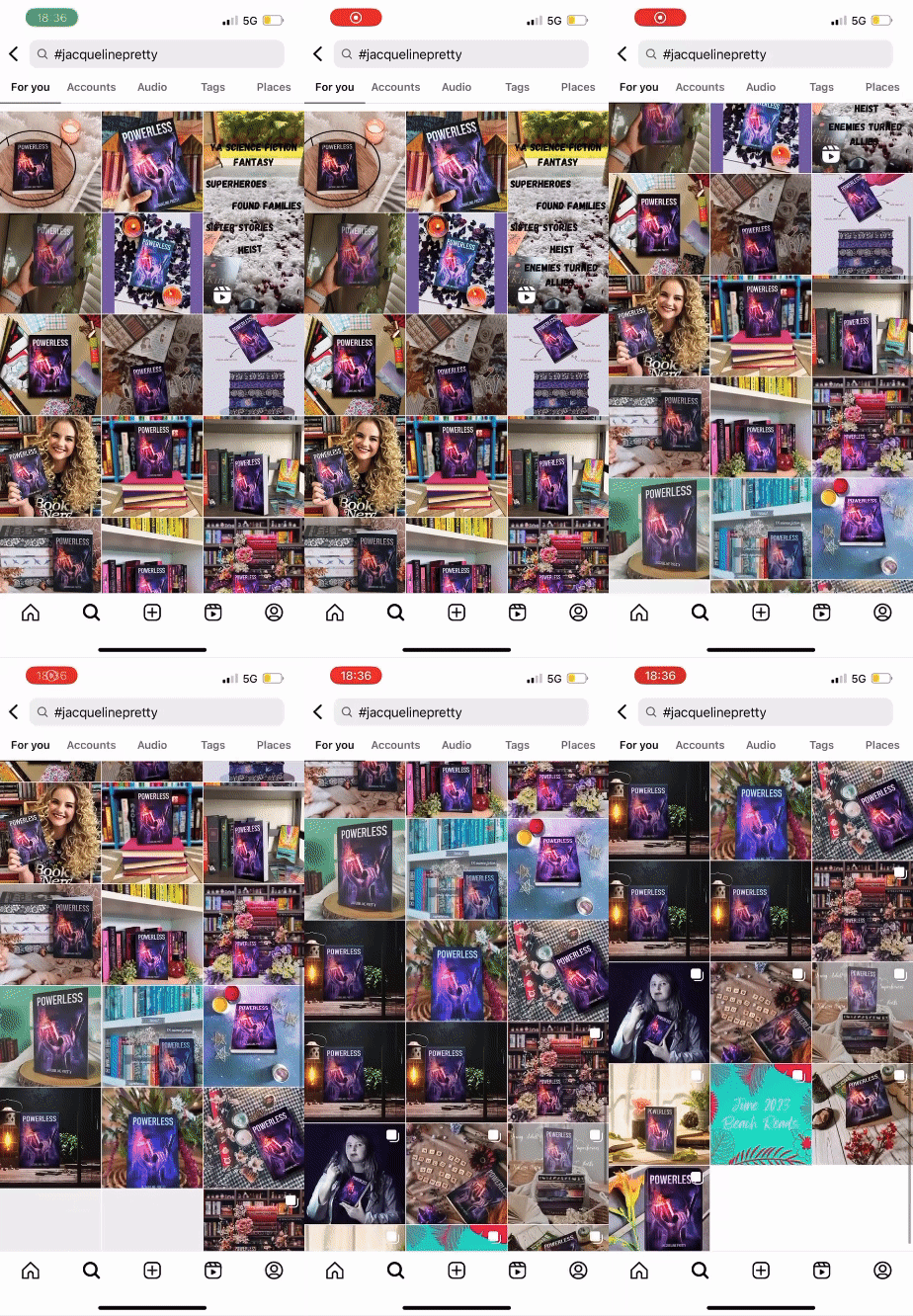
Posts shared under #jacquelinepretty

All in all, I did four book tours in my launch week, as well as working with one paid influencer and one free influencer independently, which meant 41 different profiles did posts about my book in the launch week.

These posts generally offered a giveaway (either a book or book + Amazon voucher) and required entrants to comment on the post, follow the influencer’s page and my page, and share it in their stories.

The cost of these tours was USD1,139 (AUD1,674), plus the cost of organising the giveaways. There were five giveaways (one for each tour, not one for each influencer), so that was one book each, and a couple of them had Amazon vouchers as well. The cost of the books and postage (I ordered new books on Amazon for the winners, because it was cheaper than sending copies from Australia) was USD90.44 (AUD 135.66), while the vouchers were USD65 (AUD97.50).

So that’s a total of USD1,294, or nearly AUD2,000 for influencer marketing.

What were the results?

I gained about 150 followers on my Instagram through the giveaways. It also increased awareness of my book during launch week – people were engaging with these posts and sharing stories about my book.

When it comes to sales, unfortunately there was no noticeable impact. 

On the Amazon KDP dashboard (eBook sales), I can see that most of my orders in June were on the day the book launched, after which they quickly dropped off. Because the book tours were running the full week, if they were having an impact on sales I would have expected more consistent sales numbers for that period, with a drop off the following week once the tours finished. 

I don’t seem to be able to get a one-month view in my IngramSpark dashboard (print sales), so it’s possible there was an impact on print sales, but I would assume that the general bookstagram person is more likely to spend $2.99 on an eBook by an unknown author than $13.99-$19.99 on a print copy.

On an emotional level, it was lovely to see all of the beautiful posts about my book. As an author, unless you have a launch party, a book launch is pretty anticlimactic – all your work is done, and the only change is the book’s status changing from ‘pre-order’ to ‘buy’. Without any launch celebration, it’s easy to move on to the next thing.

Having the book tours made it feel like there was a celebration happening for my book. It was exciting to see new posts everyday, and this wouldn’t have happened if I hadn’t paid for it.

The verdict? On an emotional level, there’s something really special about seeing people create beautiful images with your book. For that reason alone, I would do a book tour again, but I’d probably just work with one company rather than doing a bunch of them.

Reviews

When it came to reviews, I had a number of objectives:

  1. Build awareness about my book (new people reviewing it means new people reading it! And this is increased when they then share that review on Goodreads and other platforms!)
  2. Build credibility when it launched (positive reviews on Amazon and Goodreads means new readers would be more likely to try it!)
  3. Reach librarians and booksellers (they might stock my book!)

I submitted Powerless to both industry publications as well as community review sites for coverage.

Industry publications

The industry publications I looked at were Publisher’s Weekly and Kirkus Reviews. 

These both publish book reviews and can be good for getting the attention of traditional publishers and other media outlets. They are also good publications if you want a reputable/professional review, rather than just reader reviews (I have nothing against reader reviews – they’re awesome! My favourite reviews have come from readers. But unless that reader is a famous author, they can lack some gravitas).

Kirkus Reviews had the option of paying USD450 for a review, which I did. I submitted my book in advance, and the review came out shortly after launch – comparing my book to X-Men and Leigh Bardugo! 

Publisher’s Weekly didn’t have the option to pay for a review, so I submitted it and hoped for the best. Nothing has happened, so I’m guessing they haven’t picked it up.

However, Publisher’s weekly also has a magazine for self-published authors called BookLife – I entered a competition with them for USD90-ish (still waiting for the results), and as part of the entry I was also able to get an assessment/review.

I’ve used these reviews on my book’s page on Amazon and other retailers, as well as sharing them on Instagram and LinkedIn.

The verdict? While these reviews have added some credibility to me as an author, I’m not sure if I’d do them again. If I get traditionally published in the future, the publisher would take care of that. As an indie author, I’m not sure the investment makes sense.

Community review sites

There are also a range of websites where you can submit your book, and then their community of reviewers has access to them. I used NetGalley and BookSirens for this. Edelweiss is another one, but I couldn’t figure out how to submit my book, even after signing up with a publisher account (I requested information on this a couple of times, but never heard back).

NetGalley was the main service like this I used, mainly because the minimum contract period was six months for USD499. I signed up for that, plus USD125 to have my book promoted for a week during their YA week.

Over the six months, I got feedback from 33 users. Of those, nine people gave Powerless 5 stars, 14 people gave it 4 stars and seven people gave it 3 stars, and there were a handful who didn’t rate it. Based on those numbers alone, NetGalley was my most successful platform for getting reviews of my book.

The challenge is that many readers aren’t on NetGalley – they’re on Goodreads and Amazon, which is where authors need reviews the most. Fortunately, NetGalley allows authors to download a feedback report which includes reviewers’ email addresses, so I did this throughout the campaign and asked reviewers to share their reviews to Amazon and Goodreads.

Unfortunately, despite having sent multiple emails to reviewers to get them to copy their reviews across, many didn’t make it to Goodreads or Amazon. On Goodreads, 16 of the NetGalley reviewers shared their reviews, and across the main English Amazon sites, nine reviewers shared theirs.

This was a bit frustrating because, from my perspective, once you’ve written the review, the hard part is done. You’ve already read the book! You’ve written the review! Copying and pasting it from one site to another should be easy!

Admittedly, there are some restrictions on Amazon – you need to have spent USD50 (or local equivalent) on the site within the last 12 months to be eligible to leave reviews. As a regular kindle user, this is easy for me, and I assumed many reviewers would be in the same boat, but that might not have been the case.

Having said that, I still would have hoped that more than a third of reviews would have made it to Amazon, and more than half to Goodreads.

So, all in all, the experience was… fine? I was thrilled every time a good review came in. The problem is that most of these reviews are only on NetGalley.

Given the size of the platform, I feel like NetGalley could have some built-in API that republishes reviews to Goodreads and Amazon. If not, then at the very least they could ask users to submit Goodreads and Amazon information in their profile information, and publishers/authors could have the option to only offer their books to users with this information available. Then they could have an automated reminder system asking people to repost their review once it’s on NetGalley.

Without something like this, I don’t feel like the cost of the service is worth it – not unless you’re so well known that you have hundreds (or thousands) of people reviewing your book, which then naturally means you’ll get a decent number making their way over to the platforms that matter. Especially since you can only sign up for six months – three months would be much more economical for indie authors.

I also didn’t see any boost in reviews in the week my book was promoted, so wouldn’t recommend that.

BookSirens has a similar setup, but with some important differences:

  1. No minimum contract/listing period – you can pay USD10 to submit one book for review, then it’s just USD2 per reader (and you can limit your budget). If you have multiple books, you can pay USD100 for the whole year to submit unlimited books.
  2. Reviews aren’t posted on the platform – instead, reviewers need to have an Amazon/Goodreads profile set up to create an account.
  3. You can select where you want reviews to be posted when you submit your book.
  4. The BookSirens team follows up with people who’ve downloaded your book to remind them to review it.

This then creates an environment where readers are, theoretically, more likely to post their reviews on Amazon and Goodreads.

After signing up, I also found that BookSirens was a lot more proactive in marketing my book – they had a strategy of creating bundles of books in certain genres, and would let me know whenever my book was in a bundle. They also created graphics for this and had custom links (so your book appears at the top of the list), which made it very easy to share.

Unfortunately, I found I just didn’t get readers here. I paid my USD10 to sign up, and then only had two reviewers download my book. And, unlike NetGalley, where you are emailed every time someone reviews your book, there was no communication after my book had been downloaded, so I’m not sure if they’ve read it at all?

However, the lower price point makes it much easier to justify the risk of signing up to BookSirens than NetGalley.

The verdict? I wouldn’t do NetGalley again – the cost is too high when considering how few reviews make their way to Amazon (which is where authors need them the most). Plus, I have the email addresses of everyone who reviewed Powerless, so I can reach out to them personally when my next book is ready.

On the other hand, I would do BookSirens again – mainly because it’s so cheap that there’s no harm in giving it a go.

Advertising

I had such big plans for advertising! I was going to funnel thousands into advertising on Amazon, Goodreads, Instagram and Bookbub. Instagram was going to be about awareness and building my audience and email list, while the others would be focused on targeting readers who were interested in books like mine.

Unfortunately, this also didn’t go to plan.

Instagram

On Instagram, I wanted to do advertising around the free chapters of Powerless on my website. I figured that would help grow my list, and those people would then be more willing to buy my book. Yes, I would do some ads around the launch as well, but I really saw this as a way of selling my free chapters.

That was until I tried to boost my first post in April. Barnes & Noble was offering 25% off pre-orders, and I did a post to share the news, because Powerless was a pre-order at the time. Then I thought I might as well boost it, since the sale was for a limited time.

Unfortunately, my payment didn’t go through and Instagram blocked my ads account. It’s now six months later and I haven’t been able to solve this – the ‘request review’ form in my notifications hasn’t worked this entire time.

I’ve tried it on the app. I’ve tried it on desktop. I’ve tried multiple browsers, on both my computer and my phone. Every time, I get an error message…

Okay, I just tried again to see what the error message was, and it worked! But from the end of April until the last time I tried to submit the form (about two weeks ago), it didn’t. Clearly I just needed to blog about it to make it work 😅

In short, one of my planned advertising channels wasn’t available.

Not to worry, I thought. I’ll just put that budget into other channels…

Goodreads

There are ads on Goodreads. Apparently, you can book them. But in the lead up to my launch, I used the official form to request information on advertising on Goodreads and they never got back to me. This happened multiple times.

They do ask for your planned budget up front, so maybe my budget wasn’t big enough? (I’d planned to spend AUD1,500 on them, so was in the $1,000-$5,000 bracket.)

Again, I thought, I’ll just put the budget into other channels…

Amazon

I’d planned to spend AUD2,000 on Amazon ads. Plus the AUD1,000 I’d had planned for Instagram and the AUD1,500 I’d had planned for Goodreads, I was growing a nice little Amazon ads budget.

I set up campaigns on Amazon.com, .com.au, .co.uk and .ca. In each region, I set up both auto ads (ones where Amazon targets users they think will like your book) and ones with manual targeting (where I set the target).

The manual targeting included:

  • Authors who write similar books to me (YA SFF), whose readers might like Powerless
  • Books like Powerless, mostly genre (YA SFF), but sometimes style
  • Keywords around genre and category (e.g. ‘teen superhero fiction’)
  • Keywords relating to the title (e.g. ‘Powerless book’, ‘Powerless eBook’)

For most terms, I bid 35 cents a click, meaning that, if ten people clicked on my ads, I would spend $3.50. I also set a daily budget for each campaign (each region had two campaigns – one was the auto ads, the other was manual targeting) – I started with $30 a day for the manual targeting campaigns and $15 a day for the auto ad campaigns. With that budget, I figured I wouldn’t run out of money unexpectedly and, if something worked, I could increase the budget.

What I didn’t expect was that I wouldn’t spend the budget.

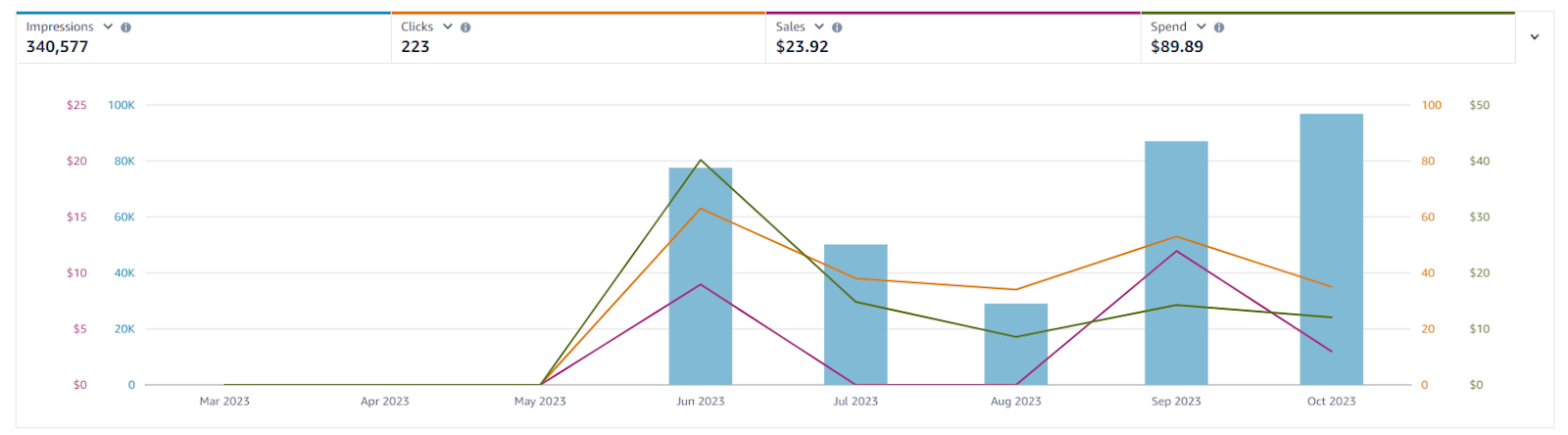
From June to now, I have spent a total of USD126.60! I had USD3,000 (AUD4,500) to spend! And I’d planned to spend that in the three weeks around the launch!

My Amazon.com advertising dashboard for Powerless (other sites have different dashboards)

This is not an issue with my daily budget being too low, because I hadn’t hit my budget. The issue is that there aren’t enough clicks to spend the budget I have.

Why?

It could be a number of things. People aren’t searching for the keywords I had in my targeting. The authors I’ve listed aren’t as popular as I thought, nor are the books. People aren’t interested in superhero books.

It could also be that people are seeing the ad, but the cover, the title, and the number of reviews aren’t enough to make them click.

Review Powerless!

If you’ve read Powerless but haven’t reviewed it on Amazon yet, do it here!
Review now!


In any case, I had this big (for me) budget, and wasn’t able to spend it. The reason I’ve kept the ads running is because, why not? It still means a couple of people are discovering the book each month, and maybe one of them will be the one who tells their friends about it or reviews it on their YouTube channel, and then it goes viral.

But it was a frustration I hadn’t expected.

I could potentially broaden my targeting – since romantasy is the big thing at the moment, I could run a campaign where Powerless appears alongside those books. My concern with that is that Powerless is not a romance – it doesn’t even have a romantic side plot. So people might not click on the ad (because the cover doesn’t look like a romantasy); or they’ll click on it but not buy (because the description and reviews say nothing about romance); or they’ll click, buy and be disappointed by the book, and then leave a bad review.

Other than that, I’m not sure what can be done.

Aside from spending frustrations, though, because Amazon ads are linked to my KDP account, it does track book sales, which makes seeing ROI very clear. I’ve made USD35 in book sales from my ads, so am currently running at a loss.

If the numbers were higher, I would be refining the ads based on this information (e.g. if 200 people clicked because of one keyword and no one bought, but 150 people clicked based on another and 10 of them bought, I’d put more budget into the second keyword and less into the first to try and build on what is working). However, because all of my results are single clicks, I don’t have enough data to be making those sorts of adjustments.

Because the budget is so much lower than what I had set aside, I’m not too worried about losing money on the ads just yet, but I’m checking in regularly to see if anything changes. 

BookBub

BookBub is mostly known for their bargain books newsletter, but they also offer advertising on their website. You can choose to be charged per click or per 1,000 impressions, and the targeting is based on a list of authors you pick.

You can do custom artwork, so I had an image with my book cover and part of a review quote. 

I’d planned a budget of AUD1,000, but set it at AUD700 to start with. I scheduled the campaign for the two weeks around my launch and guess how much I spent?

Fifty-six cents. Australian.

That’s about thirty-seven cents, US.

I don’t understand. 😭😭😭

The verdict? All in all, my advertising experience has been very disappointing. As an unknown author, I was expecting this to be how I grew my audience, so it was frustrating to be unable to use two platforms and to find the other ones ineffective.

Assuming my Instagram issue gets solved, I would definitely try that in future – it’s a different platform with different targeting options, and I still think the plan to grow my email list before pushing the book is a good one. I’ll also keep the Amazon ads open, because, why not? But I don’t think I’d try ramping them up/experimenting with new angles until I’m close to releasing Powerless 2.

Giveaways

My final marketing strategy was giveaways. I first came across Goodreads giveaways in late 2022, when I was putting together a marketing plan for Powerless for a publisher I was submitting to.

Goodreads had some great articles on giveaway campaigns they’d run in the past. Based on this information, I knew Goodreads giveaways would be a core part of my strategy.

The way it works is you pay USD119 to Goodreads to offer a giveaway of your book – I did 100 copies of the eBook each time (only available in the US at the moment).

For someone to enter the giveaway, they need to add your book to their ‘Want to read’ list. What that means is:

  1. It looks like lots of people want to read it
  2. Their friends get notified about them adding it to their list (which creates opportunities for virality)
  3. The winners can read the book in advance and leave reviews
  4. When the book comes out, the people who didn’t win the giveaway are notified that the book is now available

Sounds great, right?

In my first giveaway, 685 people requested the book. In the second, 813 people requested it. In the third, 957 people requested it. This added up to over 1,400 people adding the book to their shelves (the number’s smaller than the total of the previous three numbers because you can enter a giveaway multiple times).

In the book’s stats, I could clearly see when the giveaways happened, because each time there was a spike when the giveaway was announced, and a spike before the deadline (see the green line below – I could only get the last six months of stats from Goodreads, so those two spikes are from the final giveaway).

Stats for my most recent Goodreads giveaway

All in all, things were looking good. But, of the 300 people who got three copies, only two appear to have read it and left reviews. 

Their reviews were also some of the more negative ones on the page (one 2-star and one 3-star), which makes me wonder whether people just enter Goodreads giveaways for free stuff, rather than actually choosing genres that interest them? (One mentioned not liking YA – so why would they enter a giveaway for a YA book?)

And since then, the 1,000+ people who have the book on their ‘Want to read’ list haven’t ordered it, which makes me wonder if they were really that interested in it in the first place?

In July, I discovered that StoryGraph has also started doing giveaways, so signed up Powerless. It was USD249, but since I had so many advertising dollars left over, I thought why not?

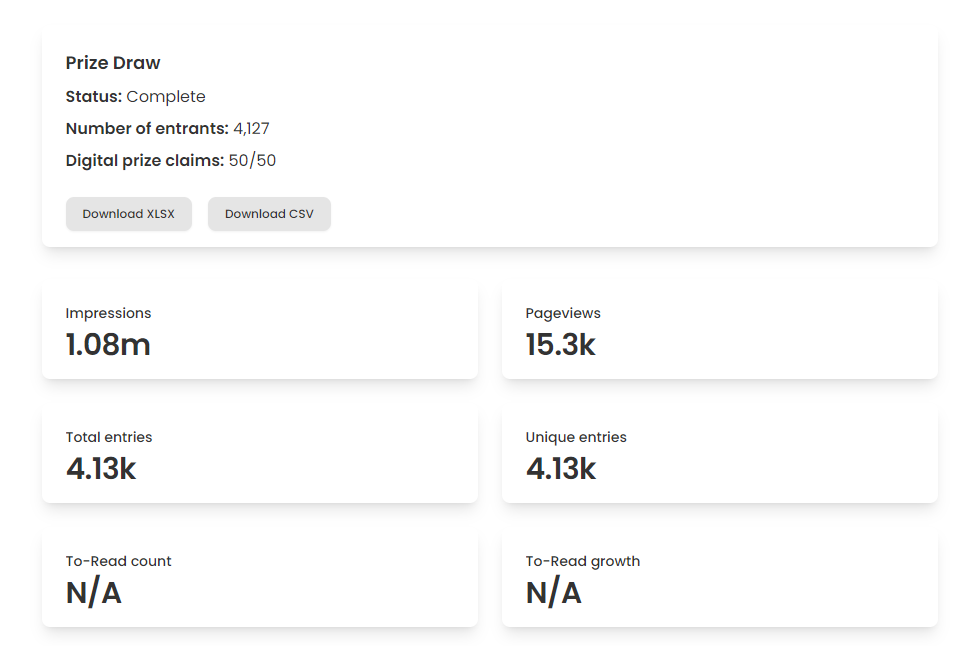
Stats for my StoryGraph giveaway

4,127 people entered the giveaway and there were 15.3k pageviews – I don’t have this visibility for Goodreads, so I’m not sure what ratio of people seeing the giveaway entered it, but on StoryGraph I’m hoping this means that if just a third of people viewing the page entered the giveaway, that third actually like YA 😅

Once it was complete, StoryGraph emailed me to let me know the giveaway was complete and I downloaded the file with the winners’ email addresses, then manually emailed them a digital copy of the book. I have no visibility on whether any of them have read or reviewed it, though I did include links to the book’s Goodreads and Amazon pages in the email.

The verdict? I do feel like Goodreads was overselling the efficacy of their giveaways in the articles I read. I can see it being part of a successful campaign, but don’t think it would work in isolation.

I think I would try a Goodreads giveaway again, but I’d just do one before the launch of a book to start building buzz, rather than doing multiple giveaways in the months leading up to the launch.

Results in a nutshell

Here are the headline numbers from my book launch marketing campaign:

  • Budget spent: USD3,202 (AUD4,804)
  • Books sold: 169
  • Books distributed via giveaways: 350
  • Reviews:
    • NetGalley: 33
    • Goodreads: 33 reviews, 46 ratings (This is all reviews, not just the ones that made their way across from NetGalley)
    • Amazon (English sites): 17
  • Audience growth:
    • Instagram: +150
    • YouTube: +49
    • Newsletter: +43

All in all, I’m chalking this up to a learning experience.

What would I change next time?

I think one of the biggest learnings here is that, without an audience, marketing a book (or any product) is an uphill battle. While I did know that, I was hoping that advertising would help fill the gap, and unfortunately it didn’t.

The most strategic approach, then, would be to focus on growing my audience, so that when the next book launches I have more people to tell about it. In an ideal world, I would ramp up my YouTube content to achieve this, since that’s the place where I’ve seen most results from consistent content in the past. This is not an ideal world, though, which means my priority is focusing on writing, not YouTube content, and I don’t see that changing for several months.

So, if my next book launch rolls around and I’m in the same position I’m in now (meaning, no audience), what would I do?

        1. Content marketing: Here I’d stick to a bare-minimum approach. As mentioned above, it’s most valuable long before a launch for building an audience. Without having an audience at launch time, there are other things with higher ROI.
        2. Bookstagram tours: I’d still do Bookstagram tours, but I’d spend more time researching tour companies to see if there are ones that are more relevant for my genre.
        3. Reviews: I’d reach out to past NetGalley reviewers for my next book. I’d also use future book content as an incentive to get people to leave reviews for past books (e.g. someone needs to send me a link to their Powerless review on Amazon to get a sneak peek of Powerless 2). I think I’ll also reach out to my audience for advance reviews, instead of relying on them for book orders, as that could help increase buzz in the lead up to launch.
        4. Advertising: Hopefully I can get Instagram sorted, in which case, Instagram ads will be a much bigger part of my strategy – mostly to grow followers and to drive people to my website to sign up for the first chapters of my book for free. I’d continue Amazon ads, but would spend more time on experimenting with higher-traffic genres that are less relevant to my book, just to see what the return is.
        5. Discounted launch pricing: Something I didn’t do this time, but which I think is worth exploring in future. 

    Let’s cover discounted launch pricing in more detail. The Powerless eBook is $2.99, and is priced at that level because that’s what Amazon recommends (they offer a higher royalty for eBooks between $2.99 and $9.99). 

    That pricing also gives you some more budget for advertising – as the profit per book is higher, you can spend more to get each individual sale. On the other hand, if you have a book priced at $0.99, the profit per book is much lower, meaning you don’t really have much left you can use to promote the book. 

    If you have multiple books, this can work in your favour – people try out a book for $0.99, and once they know they like your stuff, they are more willing to spend a bit more on other books. While you might lose money on one book, overall you are making money because that book is helping people discover your other, more expensive books.

    In addition, there are a range of book promotion newsletters available for discounted eBooks, which can increase the number of people discovering and buying your book. 

    As a first-time author, the discounted price didn’t make sense since I didn’t have a back catalogue I could send people to, and this meant I missed out on this option for book promotion. As a second-time author, though, I will have another book I can send people to, which means this is worth considering, and it becomes a more valuable strategy with every new release.

    Final thoughts

    While my book launch was, objectively, not a success, I’m not too worried about it. This is the first of what will hopefully be many books, and with each launch I’ll learn things that I can do better.

    In my case, there is also a silver lining to my book launch having failed, and that comes back to the personal issues I’ve been having. If my book had been a runaway success (if it was on the NYT bestsellers list and got a tonne of media coverage), I might have had hordes of hungry fans clamouring for book 2.

    If that had been the case, I would have felt so much pressure to keep writing – keep performing – even as my marriage was falling apart. I probably would have kept trying to refine the draft I wrote at the beginning of the year, instead of doing the complete rewrite that it needs, just to keep making progress. 

    Ultimately, I think I would have pushed forward with a subpar book, and damaged my mental and physical health in the process.

    But guess what? I don’t have hordes of hungry fans! This means I can take my time – I can heal my health, my energy and my writing, which wouldn’t have been possible if I had the pressure of a hard deadline to release the sequel.

    So what now?

    Now, my focus is healing. My ex and I have a house to sell, and then I’ll have a new apartment to move into. I’ve taken on a non-fiction ghostwriting project to help me get back into the rhythm of writing without the pressure of producing a great novel, and I’m starting to daydream about the world of Powerless once again. 

Uncategorized 0 comments

My marketing plan as an indie author

Jacqui

May 23, 2023

One of the largest pieces of my self-publishing plan has been the marketing component – both from a time and a cost perspective. 

This was a strategic decision – I didn’t want to put my book up on Amazon and leave it there on the off chance it would be discovered. No. My ultimate goal is to be a full-time author, and I believe that by investing to make my first book as successful as possible, that will lay the groundwork for future books. (There are another three in the pipeline, btw.)

Before we go any deeper, keep in mind that I haven’t done this before. I haven’t successfully marketed a book as a product. I’ve marketed books as part of a wider business strategy, with the goal of driving readers to buy an author’s products or services, but I haven’t marketed the book itself as a product. That means that my plan might not work!

That’s okay, though. I had savings that I had set aside for this campaign, so it’s not taking from money that I need to pay the bills. This means, if I make a loss, it’s just a learning experience.

So, what’s the plan?

My marketing activities fall into four broad areas:

  • Content marketing
  • Influencer outreach
  • Reviews
  • Paid promotions

Before we dive into those, though, I think it’s important to distinguish between the different goals of each activity.

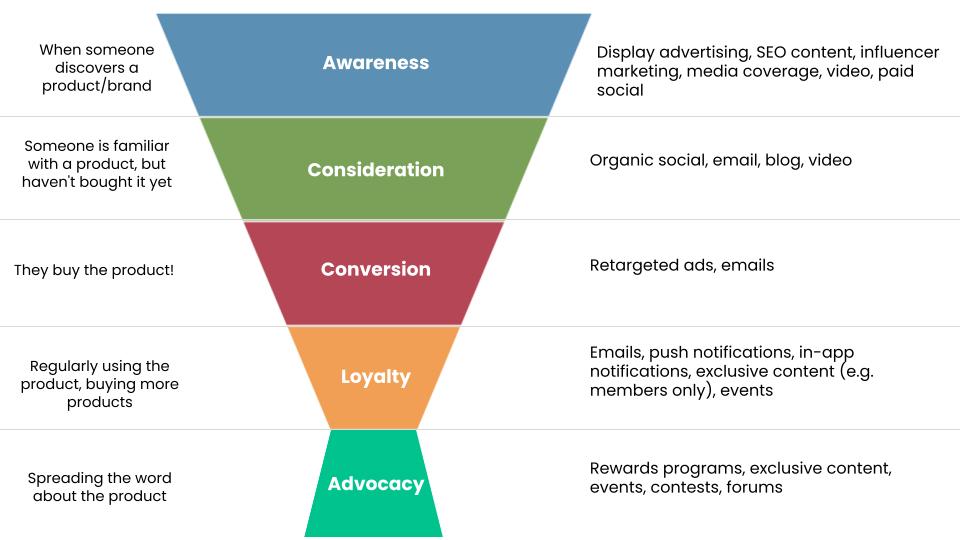
The marketing funnel

If you’re not familiar with marketing, you might not know about marketing funnels. The idea is that people are all at different stages when it comes to their relationship with your brand, product or service. They might not even know you exist, they might have heard of you but that’s it, they might be considering working with you/buying something/deepening the relationship, or they might be a customer/user/fan.

Different marketing activities target people at different stages of this funnel, with the objective of getting them to progress from one stage to the next.

This then means that the goals of each activity are different. One activity might be aimed at getting Instagram followers, another might be aimed at getting newsletter subscribers, and another might be aimed at getting sales. The more you move through the funnel, the closer you get to the sale.

My marketing plan as an indie author

Because of this, there are activities I’ve listed below that I don’t expect to translate neatly into book sales. And that’s okay! The important thing is how they work together – if the overall marketing machine is working well, then book sales should increase, even if it’s hard to see the impact of individual activities.

Content marketing

Content marketing refers to any content I create and publish. This includes:

  • This blog
  • My monthly newsletter (get access when you sign up for the first three chapters of Powerless!)
  • My YouTube channel
  • Instagram

This content usually focuses on my experience as a writer, including writing vlogs (YouTube); updates on writing progress (Instagram); and articles about writing, publishing and marketing (the blog).

Schedule

Other than my newsletter, which goes out on the second Wednesday of each month, I don’t have a strict schedule for this content. The reason for this is that it can be very creatively taxing, which means there’s a risk it will drain the energy I want to put towards writing. And, as someone who wants to publish a library of books, that is a higher priority.

On average, though, this is how the schedule has looked over the past few months:

  • Blog posts: 1x a month
  • Newsletter: 1x a month
  • YouTube: 1x every 1-2 months
  • Instagram: 2-3 posts a week

Objectives

The main objective here isn’t to sell books. It also isn’t for people to discover me. 

Both of these things might happen – you might pre-order Powerless after reading this blog post (if you do, thank you!), or you might have come across this blog post via Google, having never heard of me before. However, if these things happen, it is a bonus rather than the main objective.

Here, my objectives are:

  1. Build an audience, separate to the book
  2. Deepen the relationship with my readers

Building an audience is a long-term goal, and something that will continue long after the launch of Powerless. If the audience across my different channels grows, hopefully some of them will be interested in my books. Then, when I launch the next book (hopefully with a larger audience), it will have a stronger starting point than Powerless. (So I guess content marketing does help with book sales, but I’m expecting the impact to be felt on future books, more so than for the Powerless launch.)

Deepening the relationship with my readers is something I think is important because I’ve experienced this as a reader. I’ve fallen in love with authors, have finished reading their back catalogues, and then have gone searching for more content to consume. When I first started reading Victoria Schwab, I went back and read years of her old blog posts and watched years of her old YouTube videos, because I needed more Schwab while I waited for the next book.

Developing this content now means those readers have something to engage with in the wait between books.

Measuring ROI

Since audience growth and engagement are the objectives, the areas I’d look at to assess the success of these activities are:

  • Blog traffic
  • Newsletter subscribers
  • YouTube views and subscribers
  • Instagram likes and followers

Since you’re here…

Why not sign up for my newsletter? Once a month, get an inside look at my writing life, new release updates, interviews, events, giveaways and more! Plus, you’ll also get the first three chapters of Powerless when you subscribe 😉

Blog posts

Influencer outreach

While content marketing sits lower on the funnel (for me, at least), influencer outreach is right at the top of the funnel. It’s a way for me, and my books, to get in front of people who don’t know me.

In this category, I’m including outreach to:

  • Podcasters
  • YouTubers
  • Instagrammers
  • Bloggers

The method

Of course, it wouldn’t make sense to reach out to just any influencer – I don’t think Joe Rogan’s listeners could care less about Powerless and the types of books I want to write.

Instead, I’ve looked for influencers whose audiences have a good crossover with the potential readers of my book – influencers with book-related content, ideally with a young-adult focus.

To compile my list of influencers, I started with Google, searching for things like:

  • Best Booktubers
  • Best Instagrammers
  • Best book blogs

(There were many variations on these searches, with some referring to YA, sci-fi or fantasy, and I also tried finding teen influencers, since I’m writing for that audience.)

I then put everyone in a spreadsheet with the following columns, which meant I had all of the relevant information available at a glance:

  • Monthly traffic (for blogs)
  • Subscribers/followers
  • Average views per video (YouTube)
  • Average likes per post (Instagram)
  • Content focus (genre, age group)
  • Type of content (reviews, giveaways, etc.)
  • Last post date
  • Contact person
  • Contact details

I then started filtering. If someone hadn’t updated their page in the last few months, they were off the list (this was particularly an issue with blogs – you wouldn’t believe how many ‘top YA blogs’ lists there are with people whose websites no longer exist, or who haven’t updated since 2018).

I then created a template for reaching out, which covered:

  • How I found their page/channel/blog and what I liked about it
  • A bit about Powerless, and why I thought it was a match for their audience
  • How I thought we could work together (depending on the influencer, this might have been an interview, a review or a giveaway)

Then I started emailing/messaging people! 

Schedule

This activity had less of a schedule than content marketing. I had a few days set aside to send emails/messages, and when it came to them posting the content itself, I’ve asked them to time things around the release of the book to help build momentum

Objectives

As mentioned earlier, this is a top-of-funnel activity, so the goal is getting discovered by potential new readers. 

I also had an objective for my own activity, which was reaching out to at least 150 influencers before the launch. (Done!)

Measuring ROI

This is a challenging one, because I don’t own the platforms where the content is being shared, so I can’t see detailed analytics, and can’t track interaction from an influencer’s post to a sale of my book. 

This means I’ll need to rely on the information that’s publicly available, like likes and comments, as well as how much my own following grows as a result of this work. 

Reviews

You might be scratching your head at this point – aren’t reviews covered under influencer outreach?

Yes and no.

While some of the influencers I reached out to do reviews, in this section I’m referring to websites and platforms focused specifically on either publishing or getting reviews. These include NetGalley and BookSirens, which allow you to share advanced reader copies of the book for reviews, as well as websites like Publisher’s Weekly and Kirkus reviews, which publish reviews.

Schedule

This activity was simply a matter of submitting Powerless to the various platforms, then waiting for the response (unfortunately there’s no way to proactively target reviewers (at least, as far as I’m aware) once you’ve submitted your book).

On Netgalley, I then got an email every time someone left a review and, if they hadn’t already added the review to Goodreads by the time I saw it, I would follow up with them asking them to add the review to the platform. I’ll also be sending another email once Powerless is released, asking if those reviewers can copy their reviews to the book’s listing on Amazon.

For the review sites, it was a waiting game. Kirkus was the only site charging for reviews (the other ones were a case of submitting and hoping for the best), and their review of Powerless came through on May 16th – and they compared it to X-Men and LEIGH BARDUGO!!! 🤯

Objectives 

Because there are a couple of different types of reviews in this section, I have two different objectives.

For galleys, the first goal is the same as for the influencers – to get my book in front of as many people as possible. While there is some overlap with the influencers who might be registered on these platforms, I see them as a way of reaching people who I might not have found in my original search, as well as finding librarians, who are key for the YA audience.

There are thousands of librarians registered on these sites looking for books to add to their libraries’ catalogues. If I can get Powerless in libraries, that would be a huge way to reach new readers.

The next goal is social proof – once someone has written a review, in theory it should be easy for them to copy it to other platforms, like Goodreads and Amazon. So by registering for these services, I can also build my reviews on those platforms, which should encourage more people to read the book.

For review sites like Publisher’s Weekly and Kirkus, the goal has nothing to do with book sales. Instead, I’m thinking about my career as an author. If I get a good review on sites like these, it could help build my credibility as an author and could be used when I try querying my next book.

Measuring ROI

Measuring success is quite difficult in this area, because the world is opaque until you’re inside it. With NetGalley, I can see how many people are seeing and requesting Powerless, though it’s hard to know whether the numbers are good since I don’t know how similar books on the platform are performing. So this is more of an experiment – I’ll see if anything comes out of it and, if so, I might try it again in future.

For the review sites, the measure of success is the number of good reviews… actually, if I’m being honest, I’d consider any good reviews on these sites to be a success. 😅

Paid promotions

This final section is advertising – another top-of-funnel strategy to try to reach more readers. The main platforms I was planning to use were:

  • Amazon
  • Goodreads 
  • Instagram
  • Bookbub

Though I had to cut Instagram, due to being randomly blocked from advertising.

Schedule

Advertising can get very expensive if it’s running for a long time, so I always knew I didn’t want to be running ads for a long time. Because of this, I’ve planned everything in the weeks around the launch (the exception is Goodreads Giveaways, where I’ve done a month in the lead up to the launch).

Objectives

Advertising can be both a top-of-funnel and mid-funnel activity. 

At the top of the funnel, it would let new readers know about my book.  If they then click on an ad that links to my website, certain platforms (like Instagram) can track that activity, and can then target those people with additional ads. 

Unfortunately, the first time I tried to boost a post on Instagram my account was banned from doing ads, and I still haven’t managed to get it unblocked. 😓 So unless something changes in the next couple of weeks, I won’t be able to do any retargeting.

For the other platforms, my objectives for advertising are:

  • Get seen by as many people as possible
  • Get clicked on by as many people as possible

Measuring ROI

One of the great things about online advertising is that there’s a lot you can track. Sales are a little bit hard – while you can see sales going up, you can’t see where those sales came from (it’s different if you’re selling from your own website, as you can set up special tracking links for different ads. But when you’re selling on a third-party platform like Amazon, you don’t have the same flexibility).

What you can see is the number of impressions, number of clicks and the cost per click. While not directly trackable from the ads themselves, I’d hope to see a noticeable uptick in book sales during this period.

So the objective is to simply get these numbers as high as possible, and to see which ads get the best results (I can then put more budget behind the more successful ads).

It’s all a gamble

And that’s the overview of my marketing plan for Powerless! It’s all a bit of a gamble – I haven’t marketed a book like this before, and I’m not sure what will work and what won’t. 

In any case, I hope Powerless will be the first book of many, so anything I learn from this launch I can apply to future books as well.

Uncategorized 0 comments

The 4-year journey to publish Powerless (and how much it cost)

Jacqui

May 4, 2023

As the release of Powerless approaches (eek! Please pre-order!), I thought I’d give you a behind-the-scenes look at what went into producing this book.

If you’re considering self-publishing a book, note that you do not need to do everything I did. I’ll note after each step which ones I think are essential and which ones aren’t.

You also don’t need take as long as I did – one of the reasons that my book took so long from conception to print (almost four years) was because I originally wanted to get traditionally published, and spent over 18 months in the query trenches before deciding to start the self-publishing process. I also took long breaks between each round of drafting, revisions and feedback – partly because I wanted to come back to the book with fresh eyes, partly because I was working on other projects during the gaps, and partly because of … life (it happens). 

In hindsight, I think I could have finalised the text in 12-18 months, which still would have left time for mental breaks between each round of revisions. For the publishing process, I could have produced the book in two or three months, but I think six months is a good amount of time because it leaves space for when things go wrong (see cover design for more about this) as well as marketing. 

Finally, you don’t need to spend as much as I did. It’s possible to learn all the skills to self-publish a book yourself, and to do it for very little cost. I took the approach of outsourcing the process – I hired editors, an illustrator and designers, because:

  1. I wanted to get the best possible result (if I did my own cover, it would have been laughable)
  2. I thought it would be more valuable for me to spend the time I had outside my day job writing other books, instead of learning the skills to produce everything myself

With those disclaimers out of the way, here’s how I published Powerless!

Step 1: Write the goddamn book!

This might seem like a silly place to start, but you can’t publish a book until you’ve written said book.

For Powerless, I spent October 2019 using Save the Cat, Story Engineering and Take Off Your Pants to develop an outline. Then I wrote the first draft (68,000 words) in November and December – about 54,000 words I did in November for Nanowrimo, at which point I had a break for nearly two weeks and then finished it before the end of the year.

Would I recommend this step? Uh, yeah. If you want to publish a book, this part is kind of important.

Cost: This step can be free, though in the interest of transparency, I spent AUD49.50 on the books, and AUD12 on a 4thewords subscription. 

(A note on costs: My expenses were in a range of currencies – USD, AUD, EUR and GBP, depending on where I was living at the time and who I was working with. I’ve converted everything to AUD using current exchange rates (about AUD1.5 to USD1) to make things easier to follow.)

Step 2: Revisions

Technically ‘revisions’ could cover everything you do to turn your book from a first draft into something ready to print and distribute. For me, that process included my own reviews, working with beta readers, and working with editors. So for ease, I’ll cover my initial revisions here and will then move on to when I started getting external feedback.

After leaving Powerless in a drawer for four months, I re-read it and realised I really liked the story. Yay! (This is always a good sign.)

There was definitely room for improvement, though. My goal was to put the relationship between Hanna and her sister Maria at the heart of the story, but that didn’t really come through in the first draft. The main reason for this is because the sisters are separated at around the 20-25% mark of the story, so Maria isn’t around for a lot of it.

I addressed this by adding flashbacks throughout, which I felt was the missing piece. I also added a couple of chapters to the beginning of the book, and reworked some chapters in the middle that I felt were lagging. Once I made these changes, I sent the book to beta readers.

Would I recommend this step? Yes. Even if your first draft is amazing, you can improve.

Cost: Free!

Step 3: Beta readers

I asked three friends to read the book, and gave them a list of questions to help structure their feedback (though also said they could just send me a brain dump with their thoughts). 

Of the friends I chose, one is an editor and author, one is a fellow aspiring writer, and one is a doctoral candidate in neuroscience. I reached out to the writer friends because I thought they could give me feedback on the story, characters, world building, etc. – all the writing things. And I reached out to the doctoral candidate because there is some made-up science in the book that I wanted to feel believable.

They each had the book for 2-3 weeks and came back to me – each person sent an email/a document outlining their overall thoughts, and they also sent back the book itself with comments throughout. I also had follow-up calls with two of them. 

I went through the feedback and took note of what made sense to me (pretty much everything did). If I didn’t agree with something, I waited to see if someone else commented on it. If more than one person brought something up, I changed it. My favourite part of this process was merging the three documents that had all of their comments and seeing where the comments clustered – if there was a place where all three of them had written ‘oh no!’, then I knew I’d done something right.

Would I recommend this step? Definitely! If you don’t have anyone who might be an appropriate beta reader, though, this step could be replaced with a manuscript critique (or a couple). I think it’s important to get feedback, but there are different options for getting that feedback.

Cost: Free! I’ll send everyone a book once it’s ready, so there’s 3 books and postage to consider here.

Step 4: Manuscript critiques

In the end, I had four manuscript critiques for Powerless. These were:

  • 2020: Editor critique of the first 50 pages. This was done at the same time as my beta reads, and the goal here was both to get feedback, but also to see if I wanted to work with this editor on the whole book.
  • 2021: Critique of the entire book by a book coach. I happened to have a friend who was doing a book coaching certification, and for one of her assessments, she needed to write an editorial letter on a manuscript of around 80,000 words, so I got a free critique.
  • 2022: Critique of the first 50 pages. In early 2022 I entered Powerless in a bunch of competitions for unpublished books, and one of these had the option to get a critique for an extra fee.
  • 2022: Editor critique of the entire book, plus line editing. I booked this in when I decided to self-publish.

Okay, so what is a manuscript critique? A manuscript critique is where someone (usually an editor) reads your book and then writes a report on it. In this report, they outline what you did well and areas for improvement. The cost and level of detail may vary, so here’s what I got:

Powerless manuscript critique comparison table.

Powerless manuscript critique comparison

So the gist of what you get here (feedback on the book and areas for improvement) is similar to what you can get with a beta read. The main difference is that here you’re getting the feedback of a professional, whereas most beta readers will give you feedback as readers. Both of these are valuable.

When it comes to cost, this can vary significantly. From what I’ve seen, what I paid for the first critique was fairly standard (though this would be proportionately higher for the entire book), while the last one was very expensive. So let’s look at why!

For the final critique, I reached out to NY Book Editors to get Powerless edited. I’d been familiar with this company for years, and what I liked about them was that they only worked with editors with a background in traditional publishing. As someone who wanted the validation of a traditional publishing house, getting feedback from someone with this background was very important to me.

I wasn’t sure what level of editing they would think was appropriate for Powerless, so I submitted a sample for a sample edit. Based on this, the editor recommended a manuscript critique, with the following options:

  1. A 5+ page manuscript critique with a one-hour follow-up call – AUD3,378
  2. A 7+ page critique with a one-hour follow-up call, with margin comments throughout the book – AUD4,462
  3. Option 2 + a 20-page line edit – AUD5,064

I went for option 2, with the price being slightly higher because I’ve included the AUD248 trial edit you have to get at the beginning so the editor can assess your work.

My experience with my editor was good – he gave insightful feedback and a lot of encouragement. In fact, he thought I should self-publish, which was a good sign! He was also very generous with his time, and stayed on the follow-up call with me for over two hours as I went through the manuscript and asked questions about different comments he’d left throughout. And this is one of the things I wanted from a traditional publisher – the opportunity to bounce ideas off someone who knew what they were talking about.

Do I think the service was worth the cost, though? No. I’m glad I did it, but shortly afterwards I discovered Reedsy’s freelance marketplace, where there are a lot of editors with traditional publishing backgrounds offering their services. 

This meant I could have gone straight to the copyedit stage of the process with an editor with a similar background, thereby getting the same reassurance without the price tag. 

Would I recommend this step? If you don’t have beta readers who can provide good feedback (or if you don’t feel confident after addressing your beta reader feedback), then this can be a good option. In my case, next time I plan to focus on beta reader feedback (possibly with multiple rounds), and go straight to copyedits when I’m comfortable with the book.

Cost: Varies significantly based on the experience and reputation of your editor

Step 5: Copyedits/Line edits

Copyedits and line edits both focus on the language of your book. They both assume that the macro issues (structure, character, world building, etc.) are solid, which means it’s time to drill down into spelling, grammar, sentence structure, punctuation, etc.

Some editors will use these terms interchangeably, while some will separate them. Usually, line edits are a step higher than copyedits, looking at paragraph and sentence structure and flow, while copyedits get more into the nitty gritty.

My editor, Sara, covered both when she did my edits.

Sara is a friend and former colleague from Grammar Factory, so I was familiar with her work and attention to detail. When I decided to self-publish Powerless, I reached out on the off chance that she had some capacity, and she had a January window which fit my timeline perfectly!

She charges per hour and was generous enough to both cap her rate and the hours she expected to spend on the edit, with a total rate of AUD1,500 for the copyedit. This was absolutely worth it – she made over 4,500 changes to the final manuscript, catching so many things I never would have noticed. She also gave me the final confidence boost I needed to go to print.

Would I recommend this step? Yes – this one is non-negotiable. I don’t care how much you read or what marks you got for English in school – you need a second set of eyes on your work.

Cost: Varies depending on the editor’s experience and reputation. I paid AUD1,500.

Step 6: Internal layout & eBook design

After reviewing the copyedits, I handed my Word document to my internal layout designer to turn it into a book! This is when the content of your book is reformatted for print – in my case, to be printed as a paperback and hardcover.

Many indie authors take care of this step themselves, and I did consider it. I knew the layout of my book wasn’t going to be complex – I mainly needed chapter titles and text. 

But, doing it myself would have involved learning to use a new software, and I would have always worried about whether it looked like a ‘real’ book. I had other priorities – while all of this was happening, I was drafting two other books, working on the marketing for Powerless, and doing my day job. When I got home from work at the end of the day, I didn’t want to choose between writing and designing the pages for Powerless – I wanted to be free to focus on my writing. This meant outsourcing the page design.

I found my designer, Jessica, on Reedsy and she was incredible. My goal for my layout design was for it to look professional (like a ‘real’ book), and Jessica went above and beyond when it came to suggesting unique touches, like the DNA ornamentation on the chapter title pages (which I love!) and molecule symbols for scene separators.

Would I recommend this step? Yes. This is one of the things you can learn to do yourself (I’ve heard Vellum is a good tool for this), but it’s very time consuming, and I wanted to focus on my writing instead. 

Cost: Varies depending on the designer’s experience and reputation. I paid AUD900 for my designer to do the paperback, hardcover and eBook versions of the book.

Step 7: Proofread

The proofread is the final language check. While this can be done while your book is still a Word document, I wanted to get it done after the pages had been laid out.

There were two reasons for this. First, if anything goes wrong when the text is imported into InDesign, this gives us a chance to catch it before the book gets uploaded to Amazon, etc.. 

The second reason was that, because Sara was doing my proofread as well as the copyedit, I wanted the content to be in a different format so that it would feel like she was looking at something new. That would help ensure that she caught most (hopefully all!) remaining issues.

Sara charged AUD800 for the proofread, and not only looked at the language but also highlighted any unusual word breaks at the end of lines, which was very helpful.

Would I recommend this step? Yes, absolutely. I can see why some people might skip it, if they had a very thorough copyedit (like I did), but I feel like these language checks are essential – I don’t want any errors that will drag people out of the story, and I know my attention to detail isn’t good enough to catch these errors myself.

Cost: Varies depending on the designer’s experience and reputation. I paid AUD800.

Step 8: Cover design

In an ideal world, I would have done my cover earlier in the process. As soon as copyedits had been booked in (because copyedits mean the content is almost ready to go).

The reason for this is because you can’t really market your book without a cover. You can do a little – I started telling people about the book informally – but we are visual creatures, and having a beautiful image of a book is more likely to get attention than a line of text.

The challenge I had was, while I knew a few cover designers, I didn’t know any illustrators. And the comparison titles I was using to brief my cover designer all had illustrated artwork.

So I started looking for an illustrator. I went on Reedsy and found two illustrators who worked in YA sci-fi and fantasy. I went on Instagram and Deviantart and searched for fan art for properties I liked. I also reached out to a former colleague who had been doing a character design course when we last spoke, so I assumed he’d have some illustration skills.

The colleague asked if we could touch base in a few weeks due to some things happening in his personal and work life, so we set up a time for mid-January and he confirmed he was happy to work on the book!

I shared our working process in my cover reveal video on YouTube, which got us to the gorgeous visual we have now with Hanna’s hands holding a beaker and a gun, with a DNA chain around her wrists and images of Sudovia and a lab in the background.

While this process was largely good and I’m very happy with the final design, it took much longer than expected. The timeline we originally discussed was mid-January to the end of February, and we didn’t finalise everything until May (one month before my launch date 😬).

Here’s how it worked:

  • December – Reach out via email and share briefing document
  • January – Kick-off call in mid-January, add some more details to the brief on the designer’s request, share the book with him. First round of concepts provided by the end of the month and we both agreed on the one we liked.
  • February – Chose colour scheme and typography. The designer provided an illustrated version, but his style was quite different to the reference covers I’d provided, so we decided to go with the photographic version (this was originally just a mockup to choose the concept and layout) instead. 
  • March – Did the full paperback layout (front, back and spine) followed by the hardover layout. I ordered some paperback copies from my distributor (IngramSpark).
  • April – My copies arrived and I thought they were a bit dark, so discussed brightening them up with my designer. I sent him a copy of the book which he got in late April.
  • May – Made final tweaks to the cover (changing title formatting and brightening some elements) and uploaded new files to distributor.

Why did it take so long?

First, my designer was unfortunately going through a difficult time. In this period, he lost a family member, lost his job, and started a new one. This meant there were some times where I didn’t hear from him for a week or two. 

The second part was that my designer is an excellent designer, but he isn’t an experienced book cover designer. This meant there was a lot of back and forth on some areas, which added more time. We tried 12 different title fonts before settling on the final one (only to change it again after seeing the physical proofs). The dust jacket template provided by IngramSpark was a bit confusing, and I had about a week of back-and-forth with them trying to clarify the dimensions. And then the printed copies were darker than expected, which was hard to predict based on how the cover looked on screen (and he didn’t have the print experience to predict this).

The final piece was just related to the printed version, which was that I’m in Australia while he’s in Hungary, so it took two weeks for the book I sent him (Express!) to reach him.

Looking at the dates in our massive email thread (over 120 emails!), I estimate that these things cost us 8-10 weeks, or about two months.

Because of this, I’d still like to work with this designer for Powerless 2 (title TBC) so the covers have the same look and feel, but for future books I’d probably work with someone who is experienced in book cover design.

Having said all of that, he very generously offered to do the cover for free, so I saved significantly here. Based on my past experience publishing non-fiction books, I was used to custom cover design prices around AUD1,000 (note that you can get template covers for much cheaper – as little as AUD100). The quotes I got for this project were significantly higher due to the illustration component, ranging from AUD5,000 to AUD15,000.

Would I recommend this step? Unless you’re a professional designer, yes. People judge books by their covers all the time. Given my experience, though, I’d look for a designer who is experienced in book cover design, as it was quite stressful seeing the timelines blow out.

Cost: Anywhere from AUD500 to AUD15,000. 

Step 9: eBook, POD and distribution

Okay, time for a vocab lesson!

  • eBook: An electronic version of a book, like you can read on a kindle, Nook or mobile app.
  • POD: Print on demand, a printing system where a distributor has digital copies of a book’s pages and cover and prints them as they are ordered. This means you don’t need to pay to print 5,000 books, or to get a warehouse to store those books in.
  • Distribution: How your books get to readers. Traditionally, this was via bricks-and-mortar bookstores and libraries. Today, most people buy through sites like Amazon and Booktopia, as well as online versions of retail stores like the Barnes & Noble or Waterstones websites.

These might sound like they’re all different steps, but it all happens in one step. Basically, now that your book has been designed, you upload the files to a retailer (like Amazon) and readers can buy your book directly from them.

If you don’t have a designer who can do .epub files (the format for most eReaders), some distributors can convert the files for your printed book for you.

Once I had my pages, cover and eBook designed, I used two services for distribution – Amazon and IngramSpark.

IngramSpark is an aggregator, which means you can upload your books once, and they will feed them out to tens of thousands of retailers. So, if you use IngramSpark, your book is available for order at Barnes & Noble, Waterstones, Booktopia and more. I had used them in the past for client books at Grammar Factory, so I knew what I was getting into.

What was new was Amazon. IngramSpark covers Amazon as well, but I wanted to upload my files to Amazon directly. First, if I listed my book on Amazon directly, I could run ads on Amazon, which was part of my marketing strategy.

Second, Amazon is the world’s largest book retailer, and the majority of most indie authors’ sales come from Amazon (especially for eBoos). Because of this, I thought it was valuable to be able to see my sales data in real time.

While IngramSpark is convenient, you lose the functionality that is available by publishing directly to certain platforms, and given Amazon’s size, it made sense to exclude them from my IngramSpark distribution plans.

The challenge was, IngramSpark allows you to distribute print books before they go on sale (as pre-orders), while Amazon only allows this for eBooks. Because of this, while I would have liked to use Amazon for both print and eBook sales on that platform, I only used Amazon for the eBook (so the print and hardcover versions of the book you can see on Amazon are distributed by IngramSpark.

The process for both is fairly simple:

  1. Sign up for an account
  2. Complete a form with all the book details (title, author name, description, keywords, pricing, etc.)
  3. Upload your artwork (print files for cover and pages, and .epub file for the eBook)

The process with Amazon was very fast – the eBook appeared on the website a couple of days after I uploaded the files. 

IngramSpark was a bit slower – after I uploaded my print files, it took 7 days for them to be approved. Then I could enable distribution, and it can take up to 6 weeks before the book appears on all websites (it still isn’t appearing on some sites, and it’s been almost two months at the time of writing). In some cases, it will appear, but the information will be incomplete (my paperback didn’t have cover images on Amazon for weeks, and the hardcover version still doesn’t).

Would I recommend this step? Yes – put your books where people can find them.

Cost: Amazon was free, IngramSpark was USD49 (AUD74) per upload (I could do the paperback and eBook as a single upload, and the hardcover was a separate one, so that’s USD98 (AUD147) all up). Note that since I did my uploads, IngramSpark has removed their upload fee

Step 10: Marketing

Now that the book is available for pre-order, it’s time to market it! I’m going to do a separate post on my marketing campaign and costs, simply because it’s hard to know what I would/wouldn’t recommend when I haven’t seen results yet.

At a high level, marketing covers:

  • Self-generated content
  • Influencer outreach
  • Reviews
  • Advertising

For the first two points, there is no cost but there is a high investment of time. It takes time to write a blog post like this, or to film a video for my YouTube channel. It takes time to reach out to 300 influencers to see if they’d like to review my book or interview me.

The self-generated content is where I’m expecting the lowest ROI, but I enjoy doing it. I also can see longer term benefits to doing this sort of content – while it may not measurably help with book sales, I’m building a library of content my readers can return to. When they’re waiting in the lull between the release of one book and the next, they’ll have blog posts and videos to consume. Hopefully they won’t forget about me because of this 😅

For the influencer outreach, the gamble here is how many people will actually want to do something with me. Most of my messages have gone unanswered, but I have a handful (mostly on Instagram) who will be talking about Powerless during launch week. The goal is to get in front of potential readers I couldn’t have reached on my own. Instead of shouting into the void, I’m shouting (well, speaking nicely) to someone’s podcast audience or YouTube audience or Instagram followers.

The final two pieces – reviews and advertising – are the ones where there is a monetary cost, though there’s less of a time investment. At the time of writing, it’s looking like I’ll spend AUD5,000 on these expenses. Yes, it’s a lot, but I feel like it’s also the best chance of me getting in front of readers as an unknown author. (Originally, I’d planned to spend AUD10,000, but it’s hard to justify that number when I’ve spent so much on other parts of the process, and when I’m not sure how well the ads will perform.)

Will it be worth it? Only time will tell!

Other: Competitions

This isn’t technically a self-publishing step, but it is another expense related to Powerless, so I think it’s worth including for the sake of transparency.

Originally I’d hoped to get Powerless traditionally published, and after about six months of unsuccessful querying, I started entering it into competitions for unpublished books in the hope that it might win something and draw the attention of an agent or editor.

The good news? I won something! Powerless won the Killer Nashville Claymore Award for the best unpublished novel in the YA category, and it was shortlisted for the Chanticleer Dante Rossetti book awards. 

This didn’t get me any traditional publishing interest (though I did use it as an excuse to send out another round of queries), but the confidence boost was nice. All in all, I spent AUD590 on competition entries. For Killer Nashville, I decided to go to the conference for the awards ceremony, which added another AUD2,200 for flights from Europe, accommodation and the conference ticket.

Would I recommend this step? No. I’m glad I did it, but this expense doesn’t hold much value on the self-publishing side of things (it’s nice to say I won an award, but I’m not sure how many of my readers would actually care). I’m not sure how much weight it holds on the traditional publishing side of things either.

Cost: AUD2,800 (competitions, plus the Killer Nashville conference, flights and accommodation).

The final verdict

At the time of writing, my total budget for Powerless is about AUD21,000 (USD14,000). The breakdown is:

  • Editing: AUD8,000
  • Cover design: Free
  • Internal layout design: AUD900
  • eBook, POD, distribution: AUD147
  • Printing and postage: AUD374
  • Marketing: AUD8,850 (this includes more than just advertising, so I’ll break it down in an article on marketing costs and results)
  • Competitions: AUD2,800

Yes, it’s a lot 😅

Would I spent it all again? No, there are clear areas where I could make savings.

First, I’d cut the manuscript critiques. As I mentioned earlier, I feel like I can get this sort of feedback from beta readers, so there isn’t much value in having this as another expense (in my case, it was nearly AUD6,000!). 

For Powerless, though, I’m not upset about the extra money spent here. I really wanted the perspective of someone with a traditional publishing background. Someone who knew what was expected of that world who could tell me if my book was up to scratch. And I got that. I don’t think I’ll need it again, though.

I’d also cut the competitions, which would bring my total savings to AUD8,600 (and make my total cost AUD12,400). Having said that, I’m unlikely to get a free cover design again, so there would be some added expense for my next book.

With those expenses removed, the largest chunk of my book’s budget is the marketing costs, which are definitely a bit of a gamble. I’m not going to know what worked and what didn’t until the book comes out and I see how many people buy it. But I wanted to give my book the best chance of success, which is why I’m planning to spend that much. 

This isn’t to say that anyone else should spend this much on their debut. I’m fortunate to be in a position where I can spend this much. I’ve been saving for years to take a couple of years off to travel and write, and haven’t had the opportunity to do so, yet. This means all of this money is coming from those savings – I’m not going into debt for this book, or am I using money that should be covering the mortgage and other bills.

I also have the security of a corporate job. If this book flops, it would be sad, but it wouldn’t financially ruin me – I have a regular salary coming in. I’m also paying tax on that salary, which means I will be able to claim a lot of these expenses as a tax deduction at the end of the financial year. 

So that’s everything I spent on Powerless! 

Start Powerless for free!

Want a sneak peak of Powerless? Sign up below to read the first three chapters for free

Blog posts

Uncategorized 0 comments

7 ways you can help your favourite author… without spending a cent

Jacqui

April 11, 2023

So you’ve been following an author who has a new book coming out (like me!). The obvious way to support them is to pre-order their book… but what if funds are tight, or perhaps you like the author and want to support them, but this particular book doesn’t sound like your cup of tea. What can you do?

Fortunately there are several ways you can support authors without actually buying their book.

1. Add their book to your Goodreads ‘Want to Read’ list

If you use Goodreads, adding books to your ‘Want to Read’ list can help a book get in front of more potential readers. If you go to a book’s page on Goodreads, under the book’s description there is a section titled ‘Readers also enjoyed’ that suggests similar books.

How are these books chosen? One factor is readers’ lists. Simply, if a lot of readers have both Book A and Book B on their Goodreads list, Book B is more likely to be recommended to someone who is visiting the page for Book A.

Plus, if you have friends on Goodreads, you might have noticed that you get emails about their activity. So when you add something to your ‘Want to Read’ list, this will be included in your friends’ activity digests, which helps them discover new books!

Add Powerless to your Want to Read list. 

2. Rate and review the book on Goodreads

An interesting feature about Goodreads is that readers can rate and review books before reading them. They can even do it before a book is released!

I’m not recommending writing fake reviews about a book that you haven’t read – that doesn’t help anyone. However, you can give it a rating to indicate how much you’re looking forward to the upcoming release – five stars plus a comment like, ‘can’t wait to read this!’.

These ratings help interest potential readers in a book (like on Amazon, we judge books by the number of ratings they have and the average rating), and it also helps the book get shared among the Goodreads community via the updates about your friends’ activity.

The best part is that these reviews and ratings aren’t set in stone – when you read the book, you can update both based on your experience.

Rate and review Powerless on Goodreads. 

3. Rate and review the book on Amazon

Unlike Goodreads, on Amazon you can’t rate and review a book until it’s released. But once it is published, adding a review is one of the most meaningful ways you can help an author.

Amazon reviews have two key benefits – increasing trustworthiness and boosting visibility.

On the trustworthiness side of the equation, reviews help tell users whether a book is of a high quality, and whether it will be a good fit for them. A large number of mostly positive reviews means you feel safer in making a purchase – it feels like you’re making a good decision. And even negative reviews are helpful –  this is a sign that the reviews are genuine, rather than bought, and can let certain users know if a book isn’t right for them.

On the visibility side of things, products with more reviews are ranked higher in Amazon’s search results, which means new readers are more likely to discover new books.

If you’ve read an advance copy of Powerless or a sample, I would love it if you reviewed it on Amazon! Simply set a reminder in your calendar for June 13th, and follow the link below to leave your review.

Review Powerless on Amazon.

4. Share the book with your friends

Have a friend who loves YA science-fiction and fantasy? How about superheroes? Then let them know about Powerless!

Word of mouth is one of the most common ways readers discover new books. Goodreads has a good approach for automating this, but nothing works as well as a personalised recommendation from a friend.

This could be as simple as bringing a book up in conversation or sharing it in a message to your friend, or you could even post about an author’s new book on your social media profiles.

5. Share the author’s social media posts

Being an author doesn’t just involve writing books – marketing those books is essential if anyone’s going to read them. Because of this, your favourite authors are probably talking about their upcoming books on their social platforms.

Sharing their posts is a great way to spread the word about their new books. The best part? The hard work is already done – you don’t need to think of something to say, because they’ve already done it for you!

Here’s where you can find me on the socials:

  • Instagram: @jp.writes
  • YouTube: @jpwrites
  • Twitter: @jacquipretty
  • LinkedIn: Jacqui Pretty

6. Ask book influencers to review their book

If you’re a bookish person, I’m guessing you like bookish content. So you are probably already following a bunch of bookstagrammers, booktokkers, booktubers and book bloggers.

These influencers are always looking for new books to read (it’s part of their job description), and one of the ways they find books is through word of mouth. If enough people start talking about a book, it’s going to get their attention.

7. Ask your local library for the book

Libraries are a great way for authors to reach readers, especially if they’re writing for a young adult audience, like me. Unfortunately, it can be a challenge for self-published authors to get into libraries, due to lacking the connections of a traditional publisher.

However, readers can ask local libraries to order books in. If enough people request a book, a library will put it on their shelves, giving new readers the opportunity to discover your favourite authors.

8. Order their book!

I know, I know – this one isn’t free. But it would be remiss of me not to mention the importance of buying an author’s books.

Authors make their incomes from book sales, so buying their books is the most straightforward way to give them the support they need to write more books. It also means you have a shiny new book on your shelf!

Buying books can even help with some of the earlier items – if you buy on Amazon, your review will have the ‘verified purchase’ tag, which is more credible than a review without this. If you want to share the book on social media, you can pose with a copy of it or create a gorgeous bookstagram post featuring the cover. You can also help spread the word about the book (and the author) by sharing your copy with friends who might like it.

So if you like the sound of Powerless, I’d love it if you ordered it by clicking on one of the images below.

7 ways you can help your favourite author… without spending a cent

Uncategorized 0 comments

Why I decided to self-publish Powerless

Jacqui

February 19, 2023

When I started writing fiction, my goal was to get a traditional publishing deal. Ideally with one of the Big Five – Penguin Random House, Hachette Livre, HarperCollins, Simon & Schuster or Macmillan Publishers.

Then, when I wrote the first draft of Powerless, I thought I had something special. I wrote the first draft, set it aside, and when I picked it up four months later, I actually liked it!

Over the next year, I worked to make it the best book it could be. I got feedback from three beta readers. I paid an editor to do a critique of the first 50 pages. I had a book coach review and critique the entire manuscript.

Every time, I worked on the book based on their feedback. Until April 2021, when I decided to start querying. (For those of you who aren’t writers, this is the process of pitching your book to agents and publishers – you generally submit a query letter, and anywhere between the first 5 to first 50 pages of the manuscript.)

When I didn’t have any luck, in January 2022 I decided to enter the book into competitions for unpublished manuscripts. I thought this might help generate traditional publisher interest. While I won one of these competitions and was shortlisted in another, this recognition didn’t generate interest (though I do have a medal now, which is kind of cool).

What the first award gave me was confidence. It was now August 2022, and I told myself, “If I don’t have any interest by the end of the year, I’ll self-publish.”

Why did I want to traditionally publish?

Before getting into why I decided to self-publish, I thought it would be enlightening to share why I was so focused on traditional publishing.

The first reason was validation – I wanted someone to tell me that my book was good enough. That it was worthy. I felt like it didn’t matter how many beta readers or editors gave me feedback – until it passed the gatekeepers of traditional publishing, it clearly wasn’t fit to be published.

(Side note: Quality is not the only reason why books don’t get traditional publishing deals. An agent might love your book, but might not think it’s marketable. Or they might have too many books like yours at the moment (in my case, too many YA sci-fi and fantasy books). Or they might be planning to retire, but haven’t updated their query status. Or a dozen other reasons I can’t think of. The point is, while many books are rejected because the level of quality isn’t there, there are reasons that have nothing to do with quality that result in books being rejected.)

The second reason was marketing support. From my Grammar Factory days, I was very confident when it came to the process of publishing a book. I already had a network of designers and editors. I knew how to set up a Print on Demand book and an eBook, and how to distribute them to the major retailers, like Amazon.

Where I wasn’t confident was the marketing. You see, at Grammar Factory, our clients didn’t write books to earn money from book sales. They wrote books that would be used as a business card – they would give books away for free, knowing that handing it to the right person could lead to a $10,000 client or a keynote speaking gig. This means they didn’t need to worry about selling books.

As someone who wants to become an author, my business model would be book sales, and I wasn’t sure how to drive them. I hoped that a traditional publishing house would be able to help me with this – even if I didn’t get the same marketing budget as one of their big authors, I hoped there would be someone I could speak to for guidance or bouncing ideas around (note that I have no idea if this sort of support actually exists in traditional publishing).

So what changed?

I sent out over 80 queries. Of those 80, I had one request for the full manuscript, which was then rejected. I also had one independent publisher who wanted to set up a call to discuss my ‘wonderful book’, but after over a month of trying to find a time, I decided to end the discussion (if it was that hard to make a time to talk, how difficult would it have been to publish a book with them?).

Originally, I had intended to put Powerless aside. If it didn’t get a traditional publishing deal, I would move on to another book and return to Powerless in future – when I had a track record and a publisher might be more willing to take a risk.

But when I won the award in August, that addressed the first piece of the puzzle. My book was chosen from over 1,000 entries and deemed worthy of an award. Validation? Check.

For the marketing piece, the independent publisher I mentioned earlier asked authors to submit a marketing plan as part of their submission. This set me on a path of learning more about book marketing – I knew about doing Instagram and Facebook ads, and I knew about generating my own content (like this blog), but hadn’t put in much thought beyond that.

In this process, I compiled a list of over 300 book YouTube channels, blogs and Instagram pages, who I could approach for reviews or interviews. I learnt about Goodreads advertising and giveaways. I learnt about getting advanced reader reviews through NetGalley. And I learnt about Amazon advertising – something I’d always wanted to try, but which you can only manage yourself if you own the Amazon account that listed the book (which wouldn’t be the case with the traditional publisher).

Somewhat ironically, this independent publisher asking me to create a marketing plan gave me the confidence that I could manage my book’s own marketing campaign.

So that was a check for the marketing piece as well.

A big caveat

Note that nothing has really changed. 

Winning this award doesn’t mean Powerless is a better book – there was no change to the content between the day before it won the award and the day after it won. I might release it only to have readers say that it’s terrible and never should have seen the light of day (though I’m hoping that won’t be the case).

Similarly, I have no evidence that I can successfully market a book. All I have is a long document and some spreadsheets with my plans, which I’ll be testing in the months leading up to the release. I could invest a lot of time and a lot of money and only sell 20 books, because there’s something else that traditional publishers do that I missed in my research.

But a year ago, I didn’t think self-publishing was an option. Now I do, and now my book is coming out in June instead of languishing away in a forgotten folder on my computer.

And you know what? That feels pretty good.

Back to Top
    © Jacqueline Pretty 2026